Druuna: Creatura

Druuna: Creatura

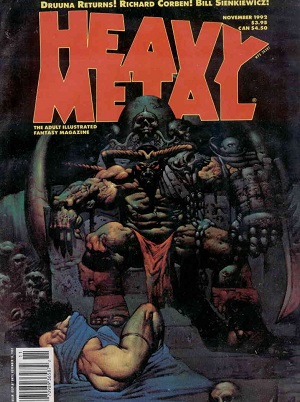
This comic (which I don’t have as a standalone but only as it appeared in the November 1992 Heavy Metal) is a sequel to the Morbus Gravis Druuna books, and there is a sort of continuity, at least insofar as continuity is a thing in the Druuna universe. The spaceship that was the setting for the earlier books has been overgrown by the Evil virus and now constitutes a sort of fleshy asteroid or floating tumor. Another spaceship captained by a man named Will comes across the asteroid, which seems to be communicating psychically with Will by giving him visions of Druuna. An away team lands on the asteroid, indeed enters it in a highly suggestive manner, and as they explore their surroundings reality seems to come undone and it’s not clear how much of what is happening is real and how much is a dream. Druuna’s lover Schastar, for example, appears to have melded into a cyborg creature that is part Schastar and part Lewis. Furthermore, he/it might have died eons ago but for the fact that time no longer has any meaning.

There’s a doctor (he seems to be a psychologist, primarily), who’s based on Serpieri himself, and he shows up to try to explain some of this to Will but I found his theories hard to follow. Otherwise, we’re just lost in the same world as before, consisting of a diseased superstructure built upon a cauldron of id that keeps looping out its tendrils to snag the buxom Druuna or any other nubile creature. The crew-cut Terry giving herself up to something called the Prolet project is another sexual-surrogate stand-in, like Hale in Morbus Gravis. In fact, she might be Hale. I don’t know.

Trying to make sense of all this is impossible. And this despite the fact that Creatura is a lot talkier than the Morbus Gravis comics. I’m just not sure how much of the supposed exposition was meant as a joke, how much was lost in translation, and how much was confused to begin with and then became progressively more complicated. It seems that something is being said about humanity existing in a parlous state between the poles of what I called the id (the Evil virus, carnality, violence, and lust) and a superego (the computer, robots, technology). While Druuna in all her lush voluptuousness would seem to be more closely aligned with the organic, that’s not represented as being an attractive alternative. Sex can be beautiful (especially on the beach), but more often it’s something cruel and degrading. Meanwhile, technology is more closely identified with what we might think of as civilization and a condition of order that we have to fight to preserve.

I won’t try to read anything more into it than that. Most of the pontificating done by the doctor and others strikes me as just a bunch of pretentious bafflegab. And by this point in the story I think it’s clear that there is no linear story being told. “Past, present and future mean nothing here,” Druuna is told by the robot Schastar/Lewis. And so she keeps running in place. There’s no escaping the human condition, even in space!

Graphicalex

Marple: The Case of the Caretaker

An interesting frame to this one, as Miss Marple is recovering from a bout of the flu and to help her recovery her doctor gives her the manuscript of a mystery story that he’s written. Only it’s really more of a true crime story as the only thing he’s done is changed the names. It’s up to Miss Marple to solve it, which she does handily the next time he comes to visit.

It’s a throwaway of a mystery. Miss Marple twigs to what’s going on because the playboy has married a rich heiress who is not his type. That’s putting a lot of weight on a pretty flimsy “clue.” Still, the story was a quick read and I enjoyed the way it was presented. Points also for making me look up what a “dower house” is, using “acidulated” to describe a gossipy spinster, and informing me that a “catapult” is a British slingshot.

Marple index

Simpsons Comics Colossal Compendium: Volume Two

Simpsons Comics Colossal Compendium: Volume Two

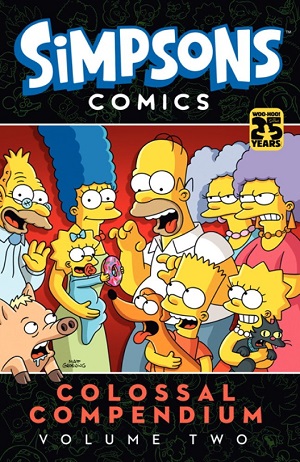
This is more like it. I was a little underwhelmed by the Simpsons Comics Colossal Compendium Volume One, though this was mainly because I judge the writing in these Simpsons comics to a high standard. I know the Simpsons universe well, at least from its earlier years, and I’ve been impressed at how the stories in the comics are still so fresh and funny decades into the franchise now.

There are some good storylines here, including a number of superhero spin-offs. There’s a Bartman story where he meets a supposed Bartman of the future (one guess as to who that is!), another where all three of the Simpsons kids are superheroes (Stretch Dude, Clobber Girl, and Bouncing Battle Baby), a blast from the past courtesy of Comic Book Guy and issue #100 of Radioactive Man, and an adventure where Homer becomes a sort of accidental costumed crimefighter as a way of losing weight.

The best story though is “No Cause for Alarm,” a comic written and illustrated by the legendary Sergio Aragonés. This follows a series of mishaps that arise when Homer gets lazy with the alarm at the nuclear power station. It’s the kind of gag humour Aragonés does well, and the story has a lot of the chaotic crowd scenes he’s famous for, made all the better for the fact that Springfield is so full of easily identifiable characters you can enjoy these pages for a while as you try to locate where your favourite citizens are hiding.

If there’s any negative comment I’d make it’s the inclusion of a couple of short Itchy & Scratchy vignettes. I’ve never understood why they kept with these. Basically they’re an ultraviolent version of Tom & Jerry, with the cat (Scratchy) always being dismembered or destroyed by the sadistic mouse Itchy. I don’t find these comics offensive or shocking, but I don’t think they’re funny either. And they always play out the same, with no twists or surprise endings (unlike Mad’s Spy vs. Spy, for example), so they’re not very interesting in that respect either. But since these only amount to a few pages of filler it’s not a big deal.

Finally, the papercraft Springfield landmark is of Moe’s Tavern.

Graphicalex

The long read

Just a note to let you know that after an eight-month hiatus I’m back posting book reviews at Goodreports.net. This was my first website, launched in 1998 (!) and I’ve operated it continually ever since. Seeing as I post a lot of reviews here, and I’m doing less reviewing in general, Goodreports hasn’t been as active in recent years. But I’ll try to keep things going with weekly updates. Most of the books are non-fiction, with a lot of current events and political matters being discussed. I kick things off with a quick look at Nouriel Roubini’s MegaThreats. Depressing stuff!

What does that even mean? Part V

This is a crosswalk. I don’t know what the traffic rules and regulations are where you live, but around here these broad white stripes mean it’s a crosswalk. And that means vehicles stop for pedestrians.

But according to the sign this isn’t a crosswalk. It’s like any other stretch of road, where pedestrians yield to vehicles.

Except it’s painted as a crosswalk.

Of course, this particular bit of signage is on campus, which is a place with its own rules and regulations. So I guess anything goes.

Index

Malignant Man

Malignant Man

It’s likely the main initial selling point for Malignant Man is that, as the back cover tells us, it was “written by Saw director James Wan.” But even this needs some unpacking.

In the first place, on the title page inside James Wan is credited with “Created and story by.” The comic itself was “Written by” Michael Alan Nelson. This put me in mind of the way the BRZRKR comics were credited as co-written by Keanu Reeves. I expressed some doubt as to how much writing Reeves actually did on those comics, but since (to be fair, after getting off to a decent start) they were terrible, and his co-writer Matt Kindt was a capable hand, it’s possible he was at least somewhat involved.

The other thing to note is that Wan did go on to produce and direct a 2021 horror film with the title Malignant, but that movie has nothing at all to do with this comic (which came out in 2011). There was apparently a deal in place to make a movie out of Malignant Man, with Wan originally slated to direct, but it never got off the ground. At least I’ve never heard of it.

On to this comic. Our hero is one Alan Gates, a fellow who has been diagnosed as dying of brain cancer. But don’t worry, he’s not going to turn into the Jigsaw Killer. Instead, after being shot in the head by some punk who he tries to stop from stealing a woman’s purse, he’s taken in for surgery where the doctors find out that his brain tumour is actually an alien parasite called a malignant that gives him super powers.

Just as an aside, I think that’s supposed to be him on the cover, but that person doesn’t look anything like the guy in the comic. Which seems like the kind of thing someone should have flagged.

Unfortunately for Alan, there are other malignants out there. Actually there are two secret societies of them, one good and the other bad. The bad ones, who look like the Agent Smith clones from The Matrix, start sending hit squads after Alan. Along with a malignant buddy named Sarah Alan kills them all, utilizing his glowing malignant blade and prosthetic shotgun.

I didn’t think there was anything special or very new about this idea, and for a short run of four comics they tried to put too much mythology into the mix. For example, we never do figure out what the malignants are up to. Maybe if the series had gone on some of that would have been explained, but this seems to have been the end of the line.

Graphicalex