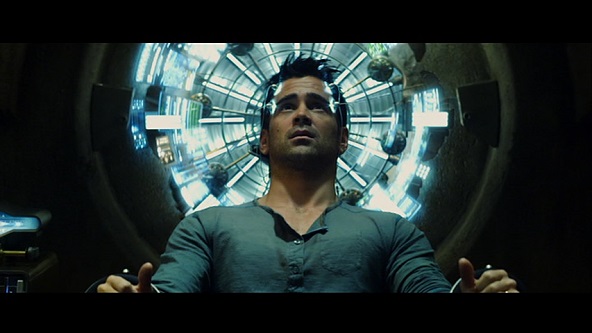
Hollywood is on a real remake binge. I think mainly because they’re out of original ideas, but also because big budgets demand projects with immediate brand recognition and because there’s a general sense out there that CGI makes everything better. Hence the remake of Total Recall (1990) in 2012 with Colin Farrell (notes just posted on Alex on Film). They shouldn’t have bothered, but I guess there was money in it. What really surprised me was finding out that the remake was partially filmed in my hometown of Guelph, Ontario. I didn’t even recognize it! Which made me wonder why they even went there . . .
Author: Alex Good
The Zombie Chronicles: Part Two
Over at Alex on Film I’ve just completed the second round of my notes on zombie cinema, taking the genre from 1990 to the present day (with the ’90s being a rather thin decade, just before the twenty-first century take off). Purists can complain all they want about what constitutes a proper zombie film, but I allow for any virus with zombie-like symptoms, and so include films like 28 Days Later and The Crazies. I also include my notes on The Purge, because even though that isn’t a zombie or zombie-virus movie it shares the same structure.
For the most part, these movies aren’t very good. Indeed, going over the list I can only see a handful of films that I would recommend seeing: Rec, Pontypool, The Horde, and Shaun of the Dead. None of these are American productions. I’m not sure if that means anything.
I suggest that 2007 may have been the year of “peak zombie,” as what we’re getting now tend to be domesticated, overblown, or parodic zombie films. The genre feels played out to me, but will likely keep going for a while based on how well it seems to suit the zeitgeist. You can see Part One of the Zombie Chronicles here.
Night of the Living Dead (1990)
Return of the Living Dead III (1993)
28 Days Later (2002)
Dawn of the Dead (2004)
Shaun of the Dead (2004)
Land of the Dead (2005)
Return of the Living Dead: Necropolis (2005)
Return of the Living Dead: Rave to the Grave (2005)
Fido (2006)
Night of the Living Dead 3D (2006)
Diary of the Dead (2007)
I Am Legend (2007)
Rec (2007)
28 Weeks Later (2007)
I Sell the Dead (2008)
Quarantine (2008)
The Horde (2009)
Pontypool (2009)
Rec 2 (2009)
Survival of the Dead (2009)
Zombieland (2009)
The Crazies (2010)
Exit Humanity (2011)
Juan of the Dead (2011)
Cockneys vs Zombies (2012)
Rec 3 (2012)
The Purge (2013)
Warm Bodies (2013)
World War Z (2013)
Zombies (2014)
Scouts Guide to the Zombie Apocalypse (2015)
Dawn of the Deaf (2016)
The Girl with All the Gifts (2016)
Pride and Prejudice and Zombies (2016)
The Night Eats the World (2018)
The Dead Don’t Die (2019)
Little Monsters (2019)
Zombieland: Double Tap (2019)
28 Years Later (2025)
Everyday rudeness #2: Biking on the sidewalk
Last week I was passed by four — four! — bikes zooming past me on the sidewalk as I was walking to the bank. This is more than annoying. It’s unsafe, because that’s a lot of weight moving at a good speed. What really bugged me though is that on that particular stretch of road there is a clearly marked bike lane, complete with pictures of a bicycle stenciled on it for those who can’t read. I didn’t see any bicycles using the bike lane.
What is the purpose of having bike lanes if cyclists won’t use them? Where does the sense of privilege and entitlement (the essence of rude behaviour) come from that lets cyclists feel they have a right to appropriate the pedestrian walkway? It’s clearly against the rules. I’m not sure if it’s strictly illegal, but I think you may be liable to get a warning for doing it. These cyclists put pedestrians at risk, especially when they’re passing you from behind and you don’t even know they’re there.
Anyway, I’ve started yelling at these people to keep their bikes on the road. I suppose this only increases the general level of everyday rudeness, but you have to draw the line somewhere.
The end of the word as we know it
Last year I had the odd experience of reading (and reviewing) two new books that came out at almost exactly the same time and that were, despite being speculative fantasies, remarkably similar: Peter Norman’s Emberton and Alena Graedon’s The Word Exchange. Both books have heroes who work for dictionary publishers, which means they’re manning the bastions against the coming digital apocalypse of cyber-barbarism. The citadel, however, is crumbling both from without and within. Literature and culture are disintegrating, along with language itself. The heroine in The Word Exchange is sure of the crisis we face:
As more and more of our actions are mediated by machines . . . there’s no telling what will happen, not only to language but in some sense to civilization. The end of words would mean the end of memory and thought. In other words, our past and future.
Reading event: Andre Alexis and Russell Smith
André Alexis, Fifteen Dogs and Russell Smith, Confidence
BookShelf Cafe eBar, May 12 2015:
The eBar at the BookShelf is a nice venue for a reading because it’s dark and cozy and quite small so you don’t have a lot of empty seats. The only problem I’ve found is that the seating isn’t always the best because it’s not oriented toward the end of the bar, where the readings take place. It’s also not a great venue if you’re on your own. It feels like you’re dining alone. Luckily, and quite unusually (for me), I was with a couple of friends.
The reading itself was exceptional. Both authors are accomplished public speakers, though in a different ways. They each read for fifteen minutes, and then answered a couple of questions after. The main question they responded to had to deal with the fate of “literary” fiction in today’s culture/marketplace. Since this is a subject I spend a lot of time thinking about I was interested in their thoughtful answers, which cast me into further reflections on the matter. André also told a great story about dogsitting a pack of howling dogs while working on a novel.
Unfortunately things wrapped up quickly and I didn’t get a chance to talk for very long to either author. Nevertheless, this was still one of the best readings I’ve ever attended, an opinion shared by the half-dozen or so people I spoke to after. It would be great to see these two together on television, or YouTube at least. This country could really use more lively, well-informed, and articulate literary discussion.
Dangerous Dining with Alex #7
Bar Burrito Large Grilled Chicken Burrito
Overview: A “fresh Mexican grill.” But doesn’t Mexico have incredibly high levels of obesity? According to a 2010 study seven out of ten Mexicans were overweight with a third clinically obese. Should I be jumping on this train?
Label: I didn’t see a nutritional guide at my location but one is easily viewable online. The only problem with it is that it only gives you information for one serving size, which I take it is the “regular” size burrito. Since I had the large burrito, what should I do? Double the amounts? That’s what I did when converting the numbers for a Subway Six-inch Sub to a Foot-long, but I’m not sure it’s entirely accurate here. Still . . . what else do I have to go on?
The thing about these numbers in nutritional guides is that they’re all slanted toward the best possible scenario. I usually eat the worst possible scenario, and more than one of them.
Anyway, assuming a large shell with double the regular ingredients the total comes to 1,320 calories. That’s about 100 calories more than the Subway sub I usually get, which sounds right. Sodium was just under Subway, probably because I was substituting chicken for cold cuts. It was still pretty dangerous though, at nearly 2,500 mg. Fat came in at 45 g (arond 17 g of saturated fats), which was surprisingly good (again, relatively speaking).
Review: Overall, I find these little guys to be a tasty and filling treat. My one objection is that they tend to go overboard on the beans. I wish I could substitute something else for all the beans but I don’t think that’s possible. I mean, you have to have some beans in there but I don’t like too much because they tend to overpower the rest of the burrito.
It’s also important to get someone who knows what they’re doing making it. This is obviously important in the wrapping because they have to be rolled up pretty darn tight so they don’t start to drip too much and come apart when you’re eating them, which is something that I’ve found to be a problem. But they also have to spread the beans out and mix the other ingredients in when they’re being assembled because otherwise you end up eating big mouthfuls of nothing but beans and shell.
I do think the price is a little high, though I guess it’s comparable to any of the specialty subs at Subway — which, for me, is this meal’s main competition. I think because it’s such a tight little package I just feel like I should be getting more for my money. Even the large burrito is only about the size of my fist. I’ve never seen a regular-size burrito so I can only imagine how disappointing they must seem.
Price: $8.25
Score: 6.5 / 10
Everyday rudeness #1: Bench hogging at the gym
Rudeness isn’t limited to merely inconsiderate behaviour that leads to minor inconvenience. Indeed, thinking of it in such terms only makes it worse. Anti-social behaviour means something and has consequences.
But what is rudeness? I suppose it takes many forms in many different contexts, but one of the most prominent today is assholery. In his book Assholes: A Theory (2012), philosophy professor Aaron James offers up the following definition:
a person counts as an asshole when, and only when, he systematically allows himself to enjoy special advantages in interpersonal relations out of an entrenched sense of entitlement that immunizes him against the complaints of other people.
At the gym that I go to the locker room is set up with a single bench surrounded by three rows of lockers. So if you want to sit down to take your shoes off or put them on, bench space can be quite limited depending on the time of day. Despite this, people regularly (and I mean every day) load the bench up with their gym bag, clothes, towels, shoes, etc., thus preventing anyone else from sitting on it (which is, after all, what it’s actually there for).
Several weeks ago one retired fellow went into a very vocal (and profanity-laden) tirade against the “young people” he saw doing this. What I’ve noticed, however, is that older members do this just as often as kids. As much as we may want to shake our heads (or fists) at such egregious displays of youthful narcissism and entitlement, it isn’t a generational thing.
At times it really gets to be a bit much. My favourite bench assholes are the ones who take all their gear out of their locker, arrange it across half the bench, and then leave to take a shower! Thus preventing anyone from using their bench while they’re not even in the general area. It’s all I can do at such times not to sweep their mess right on to the floor, where it properly belongs (why the hell do your shoes need to be put up on the bench?). And this is not something that I’ve only seen occur once or twice. I see it two or three times a week.
I’ve always wondered what would happen if someone actually confronted such assholes. My guess is that they would be baffled, if not offended. I doubt any of them would think they were doing anything wrong. And yet clearly things would become unmanageable in the locker room if everyone behaved the way they do. They simply take for granted the idea that they have a right to do what other people don’t. They are assholes.
Re-reading Shakespeare: Romeo and Juliet
(1) When Romeo is looking to buy some poison in Mantua, he knows just where to go. Earlier he had seen a very desperate looking apothecary in a “needy shop,” presumably in a low-rent neighbourhood.
Noting this penury, to myself I said
‘An if a man did need a poison now,
Whose sale is present death in Mantua,
Here lives a caitiff wretch would sell it him.’
He knocks on the wretch’s door and is told that selling drugs is a dangerous business. The apothecary is aware that it’s a capital offence (and indeed in Shakespeare’s source for the story he is later executed for selling Romeo the drug). But Romeo is able to reason with him:
Art thou so bare and full of wretchedness,
And fear’st to die? famine is in thy cheeks,
Need and oppression starveth in thine eyes,
Contempt and beggary hangs upon thy back.
The world is not thy friend nor the world’s law;
The world affords no law to make thee rich;
Then be not poor, but break it, and take this.
So much for the war on drugs. “The world affords no law to make thee rich.” That is: You have no legitimate way to make a living. But this nice rich kid from Verona will help you out.
(2) Gazing on Juliet’s comatose body, Romeo thinks he sees signs of life and attributes this to a bit of folk wisdom:
How oft when men are at the point of death
Have they been merry! Which their keepers call
A lightning before death.
Apparently this was proverbial, but why? Does it have any basis in reality? You’d think it must have been a widely observed phenomenon to have got a name attached to it, but I wonder. Or perhaps we just die differently today.
(3) What are we to think of poor Paris? When Shakespeare wants us to hate a character he can do it in a line. But Paris here seems a fairly sympathetic guy, if a bit eager to start dynasty building (“Younger than she are happy mothers made”). Structurally, he’s Juliet’s Rosaline, a potential lover to be tossed aside at the first sign of something better. But Rosaline is still out there at the end, presumably oblivious to her silent role in this tale of woe. Meanwhile, Paris is a neglected corpse. Nobody’s going to build any monuments to him! This is the real cruelty of love.
Reading event: Michael Harris
Michael Harris, Party of One: Stephen Harper and Canada’s Radical Makeover
Harcourt Memorial United Church, April 19 2015:
I walked to this event, which took nearly an hour so I was tired when I arrived. As always, I showed up early so I just collapsed at the back of the church, not even in the pews, thinking I would move up when the reading started. I soon saw that this wasn’t going to be an option. When a friend asked me why I didn’t move closer to the people at the front I told her I was waiting for them to come to me at the back, which they did. The church was filled. I estimate around 350 people were there.
That’s a lot of people for a reading, but it was also a kind of political rally, hosted by Fair Vote Canada, which is an organization promoting proportional representation (an idea I support). After Harris’s presentation there were a series of short political speeches by different party representatives. The only major party not attending were the Conservatives, though they were invited.
It was a really successful event for several reasons: it was a beautiful Sunday afternoon, there was a strong local organization behind it, and the headliner was an old pro at this kind of thing. He didn’t do a reading from the book but rather skimmed over the highlights in an anecdotal way, which kept things moving at a good pace. I think he spoke for around 45 minutes and the energy never flagged. Of course you can only do this with the right kind of book, but that’s the kind of book Party of One is so Harris ran with it. It also helped that he had an audience sympathetic to his message.
When I left I was offered a tree. I think it was a pine seedling. Nice idea, but I had no place to put it. There are days I really miss the farm.
Dangerous Dining with Alex #6
Farmer’s Market Morning Glory Muffins
Overview: If it says “Farmer’s Market” that means it has to be bad for you, right?
Label: Oh my. These come in a package of six and I eat three one morning and then three the next. That equals a truly whopping 81 g of fat (18 g of saturated fat). That’s 120% of my daily value. And that’s without butter, which I add a lot of. Also 78 g of sugar and 840 mg of sodium. 1,320 calories. I know breakfast is the most important meal of the day, but with this kind of a breakfast you can, and probably should, take the rest of the day off eating. It’s that impactful.
Review: I almost always start my day with a bowl of cereal and some orange juice, but every so often I indulge in a package of muffins. And it is an indulgence. The word has long been out that muffins are bad for you. Basically they’re no different than eating cupcakes. Tasty, sure. And since we’re biologically programmed to never have enough fat . . .
The fat is incredible. I mean, these cupcakes are downright greasy. When you slice through them the inside of the muffin sticks to the knife like it’s some kind of icing. I just hope you all appreciate how I’m killing myself to be a guinea pig for this column.
Price: $3 for a package of six on sale.
Score: 4.5 / 10