Re-reading Shakespeare: Hamlet

(1) In his book On Shakespeare Northrop Frye talks a bit about problems and pseudo-problems in Hamlet. By pseudo-problems he basically means the kinds of thing that are open for debate but that you shouldn’t be worrying yourself about. However, he then goes on to say that “there’s no boundary in the play between the actual and the pseudo-problems” and that “there’s no other play in Shakespeare, which probably means no other play in the world, that raises so many questions of the ‘problem’ type.”

I’ve always had this warning running in the back of my head when thinking of problems I’ve had with Hamlet over the years. Am I only imagining pseudo-problems, or are they real?

Well, I think they’re real, if only because they’ve never gone away. Here are some examples:

First: why, in the opening scene, does Marcellus have to explain to Barnardo why he has brought Horatio along with him to see the Ghost? We’ve already been told that Barnardo was expecting Horatio and had already discussed the matter of the Ghost with him. So why does he need to be filled in again now? Of course, the short answer is that it’s a way of informing the audience about what’s going on, but this seems a really awkward way of doing it and Shakespeare usually isn’t awkward in his handling of such things.

Second: Before he takes his leave, Laertes makes a long speech to Ophelia warning her about Hamlet’s intentions and the gap in their respective stations. Then, right after he leaves, Polonius keeps after her on the same point. Why the repetition, especially when what’s being said doesn’t seem that well-grounded in the first place? Gertrude later says that she expected Hamlet to marry Ophelia, and apparently she was fine with that.

Third: why does Claudius get so upset at the action of the play-within-a-play when he’s just seen the dumbshow? He already knows what’s going to happen and how closely it mirrors his murder of Hamlet Senior. I’ve seen various explanations for his delayed reaction – that, for example, he tries to play it cool during the dumbshow, knowing what Hamlet is up to, but loses it as the story is fleshed out on stage – but I find such explanations unconvincing. The dumbshow serves no good purpose I can see, and only makes Claudius’s later guilt-ridden meltdown more confusing.

(2) Hamlet is a play that’s full of lines so well known that reading it seems like skimming through an anthology of famous quotations. But am I the only one who finds the whole “To be or not to be” speech flabby? Meanwhile, my favourite line in the play, for its sheer quotability, is one I don’t think I’ve ever heard anyone say outside of a theatre. It comes when Horatio sadly reflects on the fate of the court ass-kissers Rosencrantz and Guildenstern. They “go to’t” (meaning go to their deaths). Hamlet responds “Why, man, they did make love to this employment.” In other words, they were asking for it by taking on the job in the first place. I find I use this line a lot, as it has many everyday applications.

It’s weird how some lines become adopted into the cultural consciousness while others don’t. I mean, how many people really think about suicide the way Hamlet does? And yet “to be or not to be” lives on.

(3) Every time I read Hamlet I find myself struck by something new. In this latest re-reading here’s something that I smiled at. It comes when Polonius is warning Ophelia about Hamlet’s lovemaking:

The canker galls the infants of the spring
Too oft before their buttons be disclosed,
And in the morn and liquid dew of youth
Contagious blastments are most imminent.

The conceit being worked here is that Ophelia’s virginity is like a bud in the spring that a blight may kill. But those “contagious blastments” . . . I mean, given that the whole tenor of the passage is sexual I don’t think there’s any way he couldn’t have meant what in our day goes by a legion of pornographic euphemisms. It’s the money shot!

On the utility of truth

Over at Goodreports I just posted my thoughts on Timothy Snyder’s little book On Tyranny. While I sympathize with a lot of what Snyder says, I think things are more complex than he makes them out to be (something I think he would agree with, as the book is meant only as a primer). One point in particular has to do with his warning about entering a post-truth era.

10: Believe in truth.

To abandon facts is to abandon freedom. If nothing is true, then no one can criticize power, because there is no basis on which to do so. If nothing is true, then all is spectacle. The biggest wallet pays for the most blinding lights.

You submit to tyranny when you renounce the difference between what you want to hear and what is actually the case. This renunciation of reality can feel natural and pleasant, but the result is your demise as an individual — and thus the collapse of any political system that depends upon individualism.

We have heard a lot about this in recent years: the rise of “truthiness,” the rejection of the “reality-based community,” the branding of any story one doesn’t agree with as “fake news.” And I agree with Snyder about the dangers of giving up on truth. What I’ve found myself wondering about more recently however is the utilitarian value of the truth for many people. For example: it’s widely accepted that man-made climate change is real. To be a climate-change denier is to reject the truth. But I’ve known such people and whenever I engage with them I come away thinking that believing in climate change is something that is of no use to them. It does them no good at all. I’m not talking about oil company executive or coal miners here either. These are just regular people for whom the truth is of no value. Or, if anything, it’s a negative. This isn’t to deny Snyder’s broader point, but it does highlight the difficulty in doing anything about it.

There’s a saying, I’m not sure of its origin, that when the facts turn against us we turn against the facts. More and more when I find myself talking with people who can’t believe the ignorance or stubborn resistance to “what is actually the case” among those they disagree with I find myself asking them why they think such holdouts would even want to believe the truth. We like to think of the truth as being its own reward, an objective good, something that will set us free. This may be overstating its worth.

On trial

Joseph K. Before the fall.

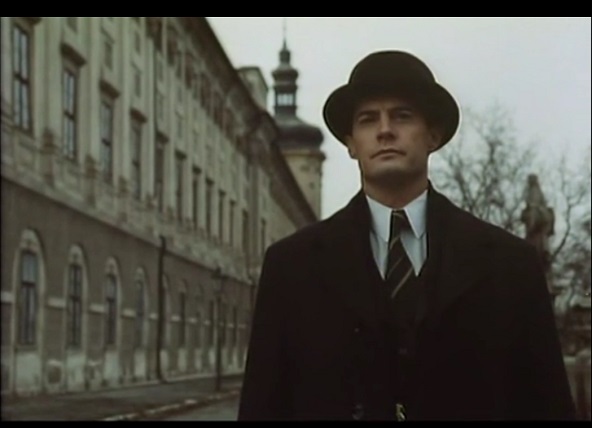
Over at Alex on Film I’ve posted my notes on two film versions of Franz Kafka’s The Trial. The first is the Orson Welles film from 1962. It’s not my favourite Welles, but he manages the text well and really makes it his own. The second is a far more literal adaptation, directed by David Jones, which came out in 1993. I didn’t like it nearly as much, but it’s still worth seeing if you’re a fan of the book.

Holmes on film

I’ve updated a few times on this site with links to my notes over at Alex on Film on various movies featuring Sherlock Holmes. Mostly I’ve been talking about the Basil Rathbone-Nigel Bruce series that ran through the late 1930s and early ’40s. If you’re interested, this is an up-to-date master list. If I review any more Holmes movies I’ll just add them here.

The Copper Beeches (1912)
Le Trésor des Musgraves (1912)
Der Hund von Baskerville (1914)
Sherlock Holmes (1916)
Der Hund von Baskerville (1929)
Sherlock Holmes (1932)
A Study in Scarlet (1933)
Der Hund von Baskerville (1937)
The Hound of the Baskervilles (1939)
The Adventures of Sherlock Holmes (1939)
Sherlock Holmes and the Voice of Terror (1942)
Sherlock Holmes and the Secret Weapon (1943)
Sherlock Holmes in Washington (1943)
Sherlock Holmes Faces Death (1943)
The Spider Woman (1943)
The Scarlet Claw (1943)
The Pearl of Death (1944)
The House of Fear (1945)
The Woman in Green (1945)
Pursuit to Algiers (1945)
Dressed to Kill (1946)
The Hound of the Baskervilles (1959)
The Private Life of Sherlock Holmes (1970)
The Seven-Per-Cent Solution (1976)
The Hound of the Baskervilles (1978)
Murder by Decree (1979)
The Hound of the Baskervilles (1983)
The Hound of the Baskervilles (2000)
Sherlock Holmes (2009)
Sherlock Holmes: A Game of Shadows (2011)
Mr. Holmes (2015)
Sherlock Gnomes (2018)

What did we do to deserve this?

Not as bad as the other one?

The rise of populist leaders and parties in many Western democracies has led to much hand-wringing over the fate of democracy itself. There may be grounds for concern, but it seems to me that another point, one which all sides might agree on, is being ignored. The quality of our leaders has gone into the toilet.

The 2016 presidential election in the U.S. was a negative affair. What I mean is that it was decided by people who were voting not for but against a particular candidate. Donald Trump (after clearing out the entire leading rank of the Republican party, who proved to be imbeciles) and Hillary Clinton (who simply bought the Democratic party wholesale) entered the campaign with the highest negative poll ratings of any candidates in history. Neither one should have had any chance of winning. Unfortunately, one of them had to.

I was reminded of this with the election of Doug Ford as head of the Ontario Progressive Conservative party heading into the upcoming provincial election. By any normal reckoning, or at any other time, I think this would be considered a disastrous choice. The supposedly smart Ford has the public persona of a loud-mouthed, ignorant boor. He is often compared to Donald Trump, and the comparisons are not all to his advantage. The idea of him being premier makes no sense. But opposing him is Kathleen Wynne, not just one of the most hated politicians in Canada but a thoroughly incompetent one as well. The only reason she is still in power is because her last opponent was Tim Hudak, who campaigned as an utter moron. Hudak was then replaced by Patrick Brown, who may be innocent of the charges of sexual harassment leveled against him but who still proved to be a complete idiot in thinking that he was going to come back and lead the party after they ran him out on a rail.

What did we do to deserve this? How did politics reach the point where such creatures have risen to the highest offices in the land? Presumably the provincial election will play out along what are becoming disturbingly familiar lines: with citizens voting against the candidate they find the most reprehensible rather than for anyone or anything in particular. Something has clearly gone wrong with democracy. That doesn’t mean that it’s doomed, but it does mean that things are moving in a bad direction.

Checking privilege

There’s recently been a bit of fuss in the news over a series of poster campaigns in British Columbia and Ontario challenging the notion of certain groups having a special social privilege. If you are male, able-bodied (“physically and mentally,” though I’m not sure what being mentally able-bodied means), Christian, a Canadian citizen at birth, heterosexual, or (most damning of all) white, then you are privileged, defined as having “unearned access to social power based on membership in a dominant social group.” For some reason being rich or coming from a wealthy family isn’t included, though I would have thought it mattered more than the rest of the markers combined. In any event, to become aware of your own level of privilege is considered a good thing, not because it becomes a source of shame or guilt, as unavoidable as that seems, but because it will lead to awareness and allow you to join in building “a more just and inclusive world.”

I’m a member of almost all of the aforementioned “dominant social groups.” And I’m aware of the fact that I’m better off in many (though not all) ways for being so. But what of it? I didn’t choose being any of these things, and I couldn’t not be any of them now without extreme difficulty. So what follows from this awareness?

In one poster a picture of Superintendent of Schools Teresa Downs appears alongside a quote: “I have unfairly benefitted from the colour of my skin. White privilege is unacceptable.” If this isn’t just empty virtue signaling, then what is Teresa Downs going to do about the unfair and unacceptable benefits she has received? Is she going to resign? Or does building a more just and inclusive world only mean getting other people to make restitution for your sins? I think it’s safe to assume the latter.

Luckily, this kind of rhetoric tends to go through cycles. Tom Wolfe satirized it in a pair of essays in 1970, later collected in Radical Chic & Mau-Mauing the Flak Catchers. In the mid-1990s radical chic became political correctness and hit another peak. It then went into remission but has since come back again. I’ve written about this before here, and my own sense is that we’ve entered into the late, silly stage of the current phase, which has resulted in the rise of such prominent anti-PC warriors as Donald Trump and Jordan Peterson. It seems the two sides depend on one another. Whatever results from all the sound and fury, I doubt it will be a more just and inclusive world.

Reading event: Michael Adams

Michael Adams, Could It Happen Here?

BookShelf Cafe eBar, March 7 2018:

The reading was supposed to start at 5:00 but didn’t get underway until 5:30. I hate to seem a grouch, but this really pissed me off. I mean, 5:00 probably wasn’t a good idea, but that was when it was scheduled to begin and it was when I (and almost everyone else who attended) was there. The delay also meant I couldn’t stay late and talk to Adams afterward, which was disappointing because he seemed quite approachable. Oh well.

Actually this wasn’t a reading. Adams was joined by a colleague at the front who asked a few general questions that he then ran with. This probably worked better than a reading anyway, especially as the stage wasn’t set up for any visual aids to be used and Adams likes to use a lot of charts to make his points.

As for the content, I came away unconvinced. Or perhaps a better way of putting it is that I remained uninfected by Adams’s optimism. In answer to the question of whether phenomena like Trump and Brexit could happen in Canada Adams thought it unlikely because our democratic institutions are more resilient and we are a more tolerant nation generally. Well, Trump and Brexit were unlikely too, and I think before they happened most pundits would have said the same comforting things about the stability of the political system and multiculturalism in the U.S. and Britain. This made me question how much time Adams spends wondering if he may be wrong. This is something that anyone who speculates about the possibility of future events should do a lot of.

Adams did acknowledge that what has really kept Canada from tottering over the edge into political extremism is that we’ve been “damn lucky.” Specifically, what I think he meant by this is that we haven’t been impacted by a major economic crisis and we haven’t had to deal with anything like the same issues with immigrations as the U.S. and Europe are facing. That is, indeed, lucky, but how long can such luck last? He also observed how Canada doesn’t have any industrial ghost-towns like you see in the state of New York, but his examples of Ontario success stories — Kitchener-Waterloo, Guelph, and Peterborough — are all university towns. Their economies are anchored by a lot of good government jobs. How stable and sustainable is that?

There’s nothing wrong with being an optimist but we shouldn’t let it make us complacent. Adams, like a lot of older, successful people, just struck me as too invested in the status quo. This appeared evident in his defence of the first-past-the-post (FPTP) electoral system, which he prefers to proportional representation (PR). He gave Italy and Israel as examples of PR gone wrong, and suggested that FPTP does a good job of keeping the crazies out. But the successes of PR are, I think, more plentiful and more telling, while Adams never adverted to the fact that Trump and Brexit both came about in FPTP systems. My own feeling is that people are drawn toward political extremes when they find the current system to be unresponsive and unrepresentative. This is something FPTP systems double down on. Eventually voters just become fed up and vote for chaos.

Overall I thought it was a good event though. I take a much bleaker view of things than Adams, but that’s OK. Now if only he could have started on time . . .

Old boys

Over at Alex on Film I’ve been watching the two versions of Oldboy: the Korean original and the 2013 American remake (where the title was changed to Old Boy).

I’m still scratching my  head as to why anyone would want to remake Oldboy. It’s a great movie, but so weird and idiosyncratic  I don’t see how anyone could have thought a Hollywood version was going to work. In the event, Spike Lee’s version doesn’t have any of the visual inventiveness and grotesque imagination of the original.