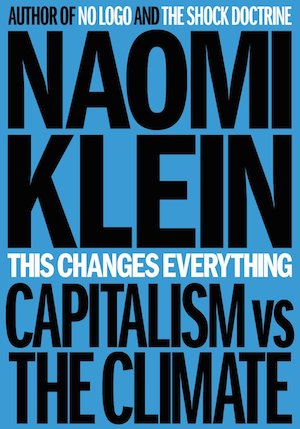
 Added my review of Naomi Klein’s This Changes Everything over at Good Reports. I believe the environment is the most pressing issue of our time, and that we are facing great challenges ahead. I don’t see how we’ll be able to hit any of the targets, no matter how modest and insufficient, that have been projected as necessary for keeping global climate change catastrophe at bay. As I say in my review of Klein’s book:
The phrase “Great Transformation” [used by environmentalists] recalls Karl Polanyi’s classic work on the birth of the market economy and the capitalist system, a development contemporary with the Industrial Revolution. That was one of the most profound shifts in all of human history, matched only by the beginnings of agriculture some 12,000 years earlier. And as Polanyi noted, the (first) Great Transformation marked a change not only in human society but in human nature.
The work of the next Great Transformation will be to effectively undo all of this, creating a new economy, or human ecology, and a new human nature, all within the next decade or so. A tall order, for which there is no historical precedent, despite Klein’s best efforts at finding one.
This is a subject I’ve returned to many, many times over the years, often repeating myself. Here, for example, is what I had to say in a review of Annie Leonard’s The Story of Stuff:
With all due respect to Annie Leonard, and I am deeply sympathetic to her concerns, her sharing, caring community in downtown Berkeley is not a viable model for a new economic order. It is an enclave, existing within and supported by industrial civilization. As Leonard correctly points out, it was the Industrial Revolution that changed the world and turned our economy into one based on mass production and mass consumption. To change things – either “back” or forward, if there is a difference – means to some extent undoing the Industrial Revolution. Unfortunately, that revolution has turned into what Ronald Wright, in A Short History of Progress, describes as a “progress trap.” There simply is no way out of it because of the sacrifice involved in tearing ourselves free.
It’s rare, and usually not a very good idea, for a reviewer to inject personal, biographical information into a review, but in this case I feel it’s warranted. I grew up, and spent a great deal of my life living on a farm. Briefly the house had no plumbing. We used an outhouse. We churned our own butter for years. We baled hay in the summer using small bales that had to be loaded and unloaded by hand. We cleaned out cattle stalls all winter – every day, seven days a week – by pitchfork. Today, I know of very few farmers – aside from the local Mennonites – who live like this. Hay is baled in massive round bales, stalls are cleaned out by automated systems or small tractors. Butter is so cheap there’s no point making your own. Or even, for that matter, growing your own vegetables (as we always did).
Most of the people I know would, I think, rather die than live the idyllic life I did growing up. And yet this is what a truly post-industrial, environmentally sustainable civilization would look like. Except it would be worse. We would not live in urban communes like Berkeley, but have to work as peasants. To pretend otherwise, to say (as many do) that we can live environmentally and still enjoy something approximating our current standard of living is the noble lie at the heart of a lot of environmental talk. Our world would be changed utterly. Even those of us lucky enough to reside in towns would find work far more labour-intensive and uncomfortable, with far less leisure time. Would we be healthier? Almost certainly. Would it be better for the planet? Absolutely. But it would not be anything like what we see described in this passage from Alan Durning that Leonard endorses:
“Accepting and living by sufficiency rather than excess offers a return to what is, culturally speaking, the human home: to the ancient order of family, community, good work, and good life; to a reverence for skill, creativity, and creation; to a daily cadence slow enough to let us watch the sunset and stroll by the water’s edge; to communities worth spending a lifetime in; and to local places pregnant with the memories of generations.”
In other words, a return to a News from Nowhere sort of medievalism. It sounds like the vision of Princess Nekayah [in Samuel Johnsons’s novel Rasselas], and is just as likely to be realized. When Pol Pot wanted to send Cambodians back to the land he had to do it at the point of a bayonet, and even so he ended up killing millions.
As I said at the end of my review of Rubin’s book [Jeff Rubin’s Why Your World Is About to Get a Whole Lot Smaller], three things will be needed to respond to the challenge of finding an environmental balance for modern civilization, each of which is a total non-starter politically: real sacrifice, meaning accepting at least some diminishment, and probably quite a lot, in our quality of life; a spirit of radical egalitarianism, meaning we all sacrifice equally; and a global consensus on action, since the problems we face have global ramifications. To say that Leonard is right in pointing out the dangers of not doing anything, of just continuing to live the way we live now, is almost beside the point. We know smoking is bad for you – a major cause of cancer and heart disease – but people still smoke. We know fast food will kill you, but that hasn’t stopped billions of people from eating it.
And these are examples where the ill effects of our behaviour are personally and (relatively speaking) immediately felt! The fact of the matter is that we are not a rational species, and we’re even worse when it comes to planning for the future.
I hate to seem this cynical, but I honestly can’t see any way out. Elizabeth Kolbert was of a similar point of view in her review of Klein in the New York Review of Books:
To draw on Klein paraphrasing Al Gore, here’s my inconvenient truth: when you tell people what it would actually take to radically reduce carbon emissions, they turn away. They don’t want to give up air travel or air conditioning or HDTV or trips to the mall or the family car or the myriad other things that go along with consuming 5,000 or 8,000 or 12,000 watts. All the major environmental groups know this, which is why they maintain, contrary to the requirements of a 2,000-watt society, that climate change can be tackled with minimal disruption to “the American way of life.” And Klein, you have to assume, knows it too. The irony of her book is that she ends up exactly where the “warmists” do, telling a fable she hopes will do some good.
In her response to Kolbert, Klein emphasized that her “book is about the huge public policy shifts needed to make . . . low-carbon choices far easier and accessible to all. It is, therefore, a book first and foremost about ideology, and the need for a dramatic move away from the dominant free-market logic that has made so many of these necessary policies seem politically impossible.”
This is fine as far as it goes, and I am in broad agreement with Klein that what is necessary is a transformation of our entire world view if we want to create a sustainable society. But Kolbert’s rejoinder is also correct:
I wrote that I found much of her book compelling, but indicated that, on several crucial issues, I found it vague. In particular, I wrote that the book glossed over the really significant—and politically unpopular—changes in American life that meaningful climate action requires.
Klein’s letter only confirms this assessment. She reiterates a claim she makes in her book that as far as cutting consumption goes, “we would need to return to a lifestyle similar to the one we had in the 1970s, before consumption levels went crazy in the 1980s.” This claim is either purely impressionistic or just plain wrong. If you look at the figures, which, once again, are readily available online, you’ll see that since the 1970s, per capita energy consumption in the US has actually declined, as have per capita emissions. How far back would we have to go to make the kind of difference that’s needed?
How far back? To a time before the first Great Transformation, before the Industrial Revolution and all it brought with it. To be fair, there are those who believe that with new technologies we can continue to maintain today’s high standards of living with a “steady state” or “zero growth” economy. In my Story of Stuff review I called this the “noble lie” of environmentalism, but it’s one that many people believe in. Marq De Villiers made the argument in Our Way Out:
De Villiers says we can still enjoy the fruits of advanced technology and live “as well as, or perhaps better than, the well-off do now” in a green society.
I find this very hard to believe.
There is another s-word that cannot be dis-attached from the idea of sustainability: sacrifice. Yes, we could all do more with less energy and shrink our carbon footprints to a fraction of their present size. The economy as currently structured is incredibly wasteful. What’s more, living locally and consuming less may very well make us healthier and happier, both as individuals and as a society.
But so what? De Villiers’s principles may be perfectly rational, but reason has nothing to do with the way we live our lives. What we want is comfort and convenience, status and respect. To take an obvious example: we know that cigarettes and fast food are expensive luxuries that are bad for us, but they are still industries worth billions of dollars. And these are products that impact our personal health directly! We haven’t been able to give up cigs and greasy burgers even to save our own lives. Our concern for the future of the planet is probably less of a priority.
It is hard to imagine our being able to enjoy lifestyles even in the relatively near future that are anything close to those in the West now. But, as George W. Bush so eloquently and correctly put it, the American way of life is non-negotiable. Some people dream of living a life off the grid, growing their own veggies, darning their own socks, using public transit, turning vacations into stay-cations, and all the rest of it. But most of us would draw a line in the sand long before giving up air conditioning, air travel, and an expensive home entertainment system.
I want to be optimistic, but as you can tell from these review excerpts, I’ve been saying the same thing for years now and haven’t read any evidence to change my mind. We may be on the cusp of a Great Transformation, but it won’t come through planning, or willingly.

 Alex Good