
This green fellow reminds me of someone whose name I can’t think of now. Not “the Grump” but something else. Pretty sure it begins with a G.
This green fellow reminds me of someone whose name I can’t think of now. Not “the Grump” but something else. Pretty sure it begins with a G.
 I’ve said before how much I love this Visions in Poetry series, and in particular how the illustrations really offer up new interpretations of classic poems. Stéphane Jorisch’s take on Edward Lear’s “The Owl and the Pussycat” is another great example, presenting the poem in a way that I’d never thought of before.
My own sense has always been that the Owl and Pussycat were an odd but natural fit. After all, opposites attract. Jorisch, however, emphasizes their difference, making them into a sort of Romeo and Juliet coupling. The beautiful pea-green boat takes them away from an apartheid society where dogs and cats and owls never mix. The other species look on at the Owl and the Pussycat and whisper. The couples that cruise by on the Chez Noah stare (no interspecies sex there!). Even the fish in the sea stick their heads out of the water to watch them sailing by. And so our happy couple, who only have eyes for each other, have to go to the land where the Bong-Tree grows to be married by a singular turkey, after buying a ring from a singular pig. Mythical beasts like unicorns and mermaids approve.
As I say, this is never the way I’ve read “The Owl and the Pussycat,” and I don’t think it’s a reading I’d adopt as my own. Jorisch does, however, very much make it his own and I thought the book another splendid entry in a series that never disappointed. I only wish they’d published more!

A blend of Merino wool and silk that a friend picked up for me in Newfoundland. It has a really light, spongy feel to it. Can’t say I have any other bookmarks quite like it.
Book: The Story of Nature: A Human History by Jeremy Mynott
One of America’s best-loved comic short story writers does a Holmes pastiche. And there’s nothing funny about it at all. I wonder if this may have been the worst story O. Henry ever wrote. Even the detective’s name, Shamrock Jolnes, is a miss. Hemlock Jones in Bret Harte’s terrific “The Stolen Cigar-Case” was funnier.
As for the story, it’s about a man looking for his missing sister in the Big Apple. After being fleeced by a police detective, and Jolnes’s inductive method being exposed as a sham, the sister’s location is whimsically discovered by a third sleuth. First published in 1904, the jokes here haven’t aged well, to the point where for most readers they might need to be explained. Which means they aren’t jokes anymore.

Just a pic from my front porch today to show those of you who don’t have snow yet what’s coming! (You can click on the pic to make it bigger.)

I often walk past these deer when I go downtown but I’ve never taken a picture because they’ve had paint on them or stickers. I guess they got cleaned up at some point so I took their picture yesterday. No, I don’t understand the meaning of the geometric forms. And yes that’s my shadow on the deer closest to you. I didn’t realize I’d put myself in the picture until I got home. (You can click on the pic to make it bigger.)
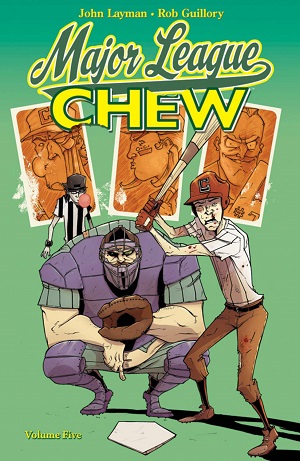 When last we left off, Tony Chu’s daughter Olive had just been kidnapped by Mason Savoy. His reasons are at least generally clear: he wants to act as her mentor, bringing her cibopathic powers along so that she can aid him in his plans, which have something to do with uncovering the conspiracy behind the bird flu. And as bad luck would have it, Tony himself is also kidnapped at the same time, by one of Amelia’s coworkers, a guy who wants to feed him the body parts of long-dead baseball players so that Tony can spill the beans on their sordid sex lives. This will allow him (the kidnapper) to score a big advance for writing a sleazy book on the subject (Superstar Sluggers’ Untold Sex Tales) after which he’ll auction Tony off to underground figures who want to do scientific testing on him.
This volume doesn’t do a lot to advance the main storyline, but it does throw in a lot of the sort of madcap madness that fans will love. Tony is busted from the F.D.A. and becomes a traffic cop, leaving his former partner Colby teamed up with a cyborg lion while working for the lusty ladies of the U.S.D.A. And once again Colby has to hop in bed with the boss to help Tony out.
A lot of the regulars are sidelined. Tony’s brother and sister only pop in as cameos, and the redoubtable Poyo doesn’t appear until the triumphant final page. It looks like he’s had some work done and is even more of a mean fighting machine than ever. There’s also nothing said about the aliens or the vampires. But we do meet Hershel Brown, a xocoscalpere. This means he can sculpt anything out of chocolate so realistically that it exactly mimics its real-world counterpart. So a chocolate machine gun or samurai sword is totally lethal. Alas, this skill doesn’t save him from being cut into pieces by some Russians (or Serbians, or “some damn thing”).
Tony gets rescued by Amelia, Colby gets a new partner, and Olive is starting to grow into her awakening powers. I haven’t been disappointed by this series yet and look forward to what’s next.
Extreme Killers: Tales of the World’s Most Prolific Serial Killers
By Michael Newton
Page I bailed on: 18
Verdict: I’ve nothing against Michael Newton. I thought his Encyclopedia of Serial Killers adequate. But the fact is that he published “more than 339 novels and non-fiction books as of 2020,” and this more than suggests that he’d become a bit of a machine. In the author’s bio for his Encyclopedia (second edition published in 2006) the number given is only “more than 180 books.” In any event, he died in 2021.
I’ve also nothing against this Profiles in Crime series. I thought Killer Cults: Stories of Charisma, Deceit, and Death adequate, if only just. But as I said in my review of that volume, I didn’t see how there was much need for such books in the age of Wikipedia anyway.
I didn’t get far into this one. The first killer covered was Gilles de Rais, a French nobleman in the fifteenth century who may have been the original Bluebeard. The second was Erzsébet Báthory, the “Bloody Countess,” a Hungarian noble who may have been the original Dracula. Both figures have since entered into legend and the real nature and extent of their crimes is a matter of some debate. Their trials can’t be divorced from the historical context, where accusations of the most outrageous behaviour weren’t uncommon. Unfortunately, establishing that context takes time, and in an anthology like this that’s not what you’re going to get, with each chapter being limited to around 15 pages. So it just wasn’t adding up to anything more than what you’d expect from a quick Internet search and wasn’t any fun to read.
 Yet another reboot origin story, this time for Doctor Strange. Except author Greg Pak doesn’t change up the original origin story (I had fun writing that) very much. It’s still Dr. Stephen Strange being an arrogant surgeon who loses use of his hands in a car accident and then seeking out the Ancient One, a mysterious figure who introduces him to the world of magic. While at the temple of the Ancient One, Dr. Strange meets Mordo, the bad student, and Wong, who will go on to become Dr. Strange’s manservant (he’s a little more independent than that here, but still fills the same role).
On the plus side it’s a pretty condensed retelling, with Dr. Strange getting up to speed just by memorizing a few incantations. After that, he and Wong and a sexy Italian sidekick are off hunting down the three rings of power to prevent Mordo from getting his hands on them. Yawn. Come on. We’re really doing this rings of power thing again?
At each stage there are portals opened and demons burst through that then have to be banished through an appeal to the Vishanti or else good ol’-fashioned fisticuffs. And Dr. Strange proves himself worthy to become a Sorcerer Supreme by renouncing the power of the rings and going back to the Ancient One to continue his training.
It wasn’t my thing. I liked the giant tiger of the Vishanti, and the art by Emma Ríos is distinct in a sketchy sort of style, but I also found it hard to read in places. The demons sometimes seem like balls of ectoplasmic yarn. And the story was underwhelming for the reasons given. Also included in this volume is a teaser for a different storyline (The Way of the Weird, which I already had a copy of), and that felt out of place even if it is just bonus content. The origin story there is presented as a flashback to the original, and not to the book we just read.
If you’re a Dr. Strange fan I’d give this a look mainly for the different style of the art, but otherwise it should be a pass.
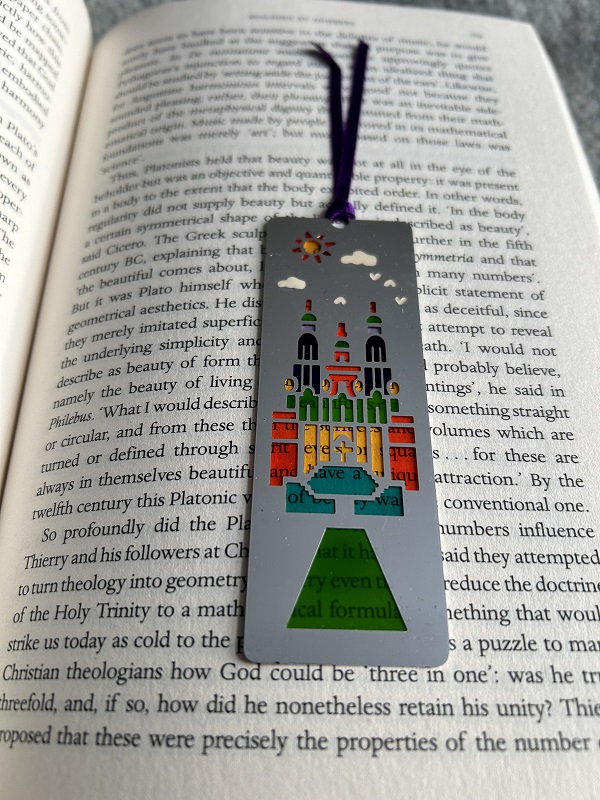
I had to take this picture from a different angle because it’s a mirrored bookmark and I didn’t want to show my phone’s reflection. I like how you can see through the stained glass windows, and it’s really quite a striking bookmark when you hold it up to a window.
Book: Universe of Stone: Chartres Cathedral and the Invention of the Gothic by Philip Ball
 Alex Good