
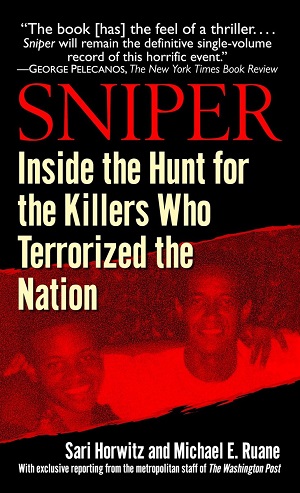
Sniper: Inside the Hunt for the Killers Who Terrorized the Nation
By Sari Horwitz and Michael E. Ruane
The crime:
For a period of three weeks in October 2002 a pair of men – John Allen Muhammad and Lee Boyd Malvo (the latter aged 17 at the time) – terrorized the Washington D.C. metropolitan area by killing 10 people and injuring several more in a series of random sniper attacks. Prior to the sniper outbreak they had committed a number of other deadly attacks across the U.S. After their conviction on multiple counts of murder Muhammad was executed by lethal injection and Malvo sentenced to life in prison.
 The book:
I think the word “terrorized” in the title is particularly apt. While it’s hard to think of Muhammad and Malvo as domestic terrorists since they didn’t seem to have any political agenda, they really did scare the hell out of people living around D.C. in these weeks. Sudden death might strike anyone randomly, even out-of-doors in public areas like parking lots and gas stations. Where was anyone safe? Only staying at home with the doors locked and the curtains drawn.
I say this off the top because for all the horror of these crimes, there was also something comic about the snipers’ reign of terror. I even found myself laughing at their failed attempts to take credit for the murders and so get the attention of the media. They were the biggest news story in the country and tried on multiple occasions to open lines of communication to the public and the police but couldn’t get anywhere. No one would believe they were the snipers. Wandering from pay phone to pay phone, they called the tip line, the FBI (four times), and CNN, all in vain. “Frustrated at their inability to be taken seriously,” they felt that the only thing they could do was escalate.
This must have really made them angry. Unlike terrorists looking to draw attention to a cause, Muhammad and Malvo were just into playing God. They even instructed the police to “Call me God.” They liked to exercise absolute control over the lives of others. And they couldn’t get anyone to take their calls!
This desire to play God is all the motive I can come up with. Muhammad was the prototype of the violent, bitter loser whose life had reached a breaking point. Things may have kicked off with his trying to kill his second ex-wife, who he was in a custody battle with, and then spiraled out of control after that. As one ATF agent speculated in the early days of the investigation, “the shooter was one very angry guy, on some kind of personal mission.” For his part, Malvo made some claims to having a larger political agenda and dying for “the revolution,” but this was only after he’d been caught, and much of what he had to say simply didn’t make any sense. For example, declaring that he hated white people but killing people of various races.
Profilers weren’t of much use. Even the ones who took to the airwaves:
The consensus of TV profilers was that the person responsible for these shooting was most likely a white man with a military background, familiarity with firearms, and a grievance. Detectives chuckled that it was the same profile the experts always seemed to produce, no matter what the case. One retired FBI profiler, Gregg McCrary, could see no real motive. “You’re down to the thrill of the kill,” he said. “Playing God. Having the power over these individuals. Life and death. That’s real heady, a real rush. He’s on a high now.”
Does any of this bring us closer to understanding the odd relationship between the two? Muhammad presented Malvo as his son, and friends who saw them together thought their interactions were very much a “father-and-son deal.” In jail Malvo would also insist that he be called John Lee Muhammad and be referred to as Muhammad’s kid. People considered him to be “enchanted” or under a “spell.” Was there more to their relationship than this? At trial, Malvo’s attorney took the line that Malvo had been groomed, even “sissified” by the older man, “just as surely as a potter molds clay.” But while there was speculation about a sexual relationship this was hotly denied (“We Jamaicans don’t play that”) and one could even wonder about how dominant a figure Muhammad was. It’s still unclear, for example, who did the shooting, though I think the common understanding is that Malvo was the usual trigger man as he was a better shot. It’s also the case that Malvo was the one who made the phone calls to the media. Was this a case of folie à deux, or shared psychopathy? Obviously it was to some extent, but I’m still unsure of the actual dynamics. And it’s unlikely we’ll ever know more.
(As an aside, it’s mentioned at one point that the police were having difficulty fitting the killings into one of the “five standard motives for homicide.” I wasn’t aware of these, but they’re listed as greed, power, revenge, hate, and escape. These seem too general to be very helpful to me. I would have thought there’d be quite a bit of overlap, for example, between power, revenge, and hate.)
Adding to the mystery of motive is the fact that this was a very odd murder spree. I can’t think of any other cases quite like it. Subsequently there were a pair of serial sniper attacks in 2003 (in Ohio and West Virginia), but they weren’t really comparable. There had been four victims in total in those two cases, and both times the sniper worked alone. And of course Charles Whitman had killed more than a dozen people when he shot up the University of Texas at Austin in 1966, but that had been a single event. The D.C. snipers were something different.
That uniqueness, and the terror that I started off talking about, is one reason why their rampage is still remembered today. At least I remember it well. Talking to a couple of friends (both older than me) while I was reading this book, however, I was surprised that neither of them had any recollection of the attacks at all. To be sure, many crime stories attract an enormous amount of media attention at the time, and over the course of a trial, only to be completely forgotten a few months, or even weeks later. How many people remember Scott Peterson, Casey Anthony, or Jodi Arias today? Only true crime junkies. But I would have thought this case on another level.
The book itself is adequate, or even better than that, being written by a pair of Washington Post reporters who covered the story. In a just-the-facts manner the bullet path for each killing is described precisely, which is a surprisingly effective approach. The opening killing of James D. Martin sets the tone:
The bullet struck Martin square in the back, slicing through his suit jacket and dress shirt and leaving a tiny hole in his skin one-eighth of an inch wide, smaller than the head of a plastic push pin. It cut through vertebra T7, below his shoulder blades, and severed his spinal cord, instantly paralyzing his lower body. Slowing down, it tore a slightly upward path, perforating his aorta, the main trunk of his cardiovascular system; the pulmonary artery to his lungs; and the pericardium, the membrane surrounding his heart. There was little deflection en route and almost no fragmentation as the bullet burst through his sternum, making a hole three-quarters of an inch by one-half inch shaped like a piece of broken glass. Later, at the autopsy, the medical examiners would find on his neck a tiny shard of gray metal that looked like lead.
Martin began to fall as soon as his spinal cord was cut. The catastrophic drop in blood pressure cause by his other wounds would have then led to swift unconsciousness. The brain carries only about a ten-second reserve of oxygen. A witness heard him moan and saw him crumple onto his left side, losing his glasses. He struck his face on the blacktop, gashing his nose and forehead.
If the keynote for these killings was terror or fear, it’s moments like these that underline their horror. I think it’s explicit without being exploitive, and authenticates the violence in a way that really brings it home.
Noted in passing:
When Muhammad was finally apprehended his wallet contained “a phone card, Muhammad’s Washington State driver’s license, three fake ID cards, and $32 in Canadian money.”
I guess he had the Canadian money because he’d been living for a while close to the Canadian border, but it’s never mentioned in this book if Muhammad ever visited Canada and he certainly hadn’t been there recently. According to Malvo’s testimony the two had planned to escape to Canada at some point so maybe there was a reason for it, though $32 wouldn’t have taken them far.
But why do people keep thinking they can escape to Canada anyway? What do they think Canada is? I mentioned this before in my review of Let’s Kill Mom but the killer kids in that book lived in Texas and weren’t too bright so you could perhaps forgive them for thinking Canada was a sort of Cuba with snow. Muhammad should have known better, and probably did.
Takeaways:
It’s best to ignore attention-seekers, and narcissists in general. But be ready for when they blow up.
 Alex Good
I vaguely remember the news reporting this over here, but there are so many shootings in America the details get lost in my mind.
LikeLike
It’s amazing when you dig into the reporting how many multiple shootings there are in the U.S. every day that you never even hear about. I remember this as being quite the sensation at the time and was a little surprised my friends had forgotten it. But it was a quarter-century ago.
LikeLiked by 1 person
I remember this because of the complete and utter randomness of it. and with it being DC, boy howdy did the mainstream media play it up for all it was worth…
LikeLike
I think the reason I remember it is because it was such a strange murder spree. Can’t think of anything else quite like it. And it did draw a lot of media attention yeah.
LikeLiked by 1 person
I also remember that as soon as they were caught, the media coverage dropped to zero.
LikeLike
I’ve long thought that if a terrorist organization really wanted to do some damage, this is what they’d do. With roving teams of snipers randomly picking people off all across the country they could really shut us down. I know I always hate it when some violent criminal escapes anywhere in my general area. Imagine if he was randomly picking people off all the while. And if there were a bunch of them and they were organized………..
Of course, nowadays (like serial killing, which has been seriously declining since the 80s) it would be hard to get away with this for long. All the advancements in detection and all those damn cameras everywhere!
LikeLiked by 1 person
Yeah, the growth of the surveillance state has taken a toll on serial killers. While mass murder events continue the same.
Probably some of the same issues that a terrorist organization would face. Again, they have to plan major events, like blowing up a building. They can’t sustain a long criminal campaign.
LikeLiked by 1 person