Crime and Punishment
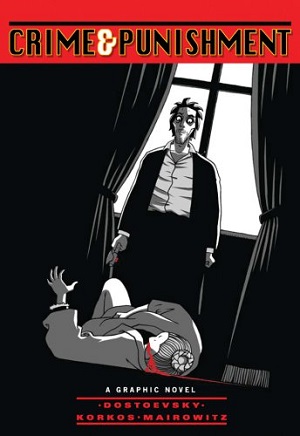 There is a point in updating the classics. Sure we can make the argument, and a good argument too, that Shakespeare is our contemporary. But that isn’t always easy for everyone to grasp, which means there’s nothing wrong with adapting Shakespeare, or any author, into modern forms like film or the graphic novel. It’s not that different from just putting Shakespeare on stage in modern dress.
This is a subtly modernized adaptation of Crime and Punishment. We’re in Putin’s Russia, but we only know that because we can see Putin’s face on TV or in portraits in the police station. And that’s not jarring because Putin sees himself so much as a “new tsar.” Then there are ‘80s-style punks in the street of St. Petersburg and they don’t seem out of place either because if Dostoyevsky was writing at a period when Imperial Russia was in decline you could see that historical moment rhyming with the Soviet Empire’s final days.
Is Raskolnikov our contemporary though? The night before I wrote up these notes I was at dinner with friends and the subject came up as to whether having a conscience was something that was in decline. At one point in the evolution of our species a conscience probably served a purpose, but in more atomized societies like our own, where our most prominent and successful role models (individual and corporate) are psychopaths, it may be that a conscience is the psychological equivalent of a tailbone. Meanwhile, narcissism is seen as a superpower as often as it’s described as a plague.
All of this is sort of by the way though in discussing this graphic novel version of Crime and Punishment because it’s not really interested in Raskolnikov’s tortured conversion. In fact, I wasn’t even sure he had experienced a conversion. He’s flattened out quite a bit here by Alain Korkos, with spiky hair and hollowed-out or whirlpool eyes being made to do a lot of work in representing his madness. Snippets of his theory of the man who has risen above conscience get dropped into the mix, but I don’t think David Zane Mairowitz, who wrote the adaptation, wanted to go into that too deeply either.
Where I think this version of the story is strongest is in the presentation of some of the supporting characters. Raskolnikov’s sister Dunya is a fresh-faced hotty and we can feel there’s something more than a family attachment in some of the drawings. Luzhin is an ‘80s pimp in a three-piece suit, aviator shades, and a cigarette dangling from his lip. Svidrigailov is a cultured sugar daddy. Sonya is a goth pauper-princess. About the only interpretation I didn’t agree with was the police investigator Porfiry, who is a goateed fellow with round sunglasses. He looks threatening, but without any of the depth or humour that readers of the novel will recognize.
Of course reducing a brick of a novel into a 120-page comic necessarily means you’re losing a lot. What’s left is coherent in terms of the story and I think relatively faithful to the original, but it isn’t close to being a substitute or even a summary. Nor, despite the modern setting, does it have much of a new spin to put on things. Was Raskolnikov the equivalent of a punk? The kind of guy to have a Sex Pistols poster hanging in his room? Or was he more intellectual than that? It’s an interesting question to entertain, but it’s also a kind of dead end that I don’t think leads us any further into the sort of ideas Dostoyevsky was digging into. Or maybe we just live in a less serious time.
 Alex Good
It seems a bit pointless if so much is lost and nothing gained from it.
LikeLike
When it works it draws some new insight into works that a lot of people feel are too distant now to be relevant. At its worst it’s a gimmick. I think they sort of fell somewhere in-between here.
LikeLiked by 1 person
Dumbing down a great story for idiots. That’s what this is.
I’m not sure what else I can say that isn’t down right unfriendly 😀
LikeLike
You have a reputation to uphold as a contrarian!
LikeLiked by 1 person
That I do. It’s a job I take VERY seriously. Otherwise some punk kid will think he’s the first one to ever be contrary. I’ll show him!
LikeLike
Those kids never learn.
LikeLiked by 1 person
Besides, if I don’t show them how to do it, they’ll mess up and end up being pansy contrarians. Nothing worse than a pansy contrarian who can’t actually call a spade a shit stick. Before you know it, that’ll lead to them saying everything is “nice”. Brrrrrrr…..
LikeLike
I’ve got the Classics Illustrated for White Fang……
LikeLike
The “classic” Classics Illustrated are fantastic. Who can forget their War of the Worlds? The latest ones aren’t as special.
LikeLike
I may have one or two others as physical copies left from my childhood, but White Fang’s the only one I’ll swear to, and I can definitely say I don’t have War of the Worlds. However, not all that long ago I laboriously downloaded the entire original set (there’s 160+), as well as at least as many more Specials, Junior editions, and others as CBR files. So, electronically, I do have War of the Worlds (and everything else).
LikeLike
I’ll have to look of White Fang. I remember eating the War of the Worlds one up when I was a kid.
LikeLike