Daredevil: Supersonic
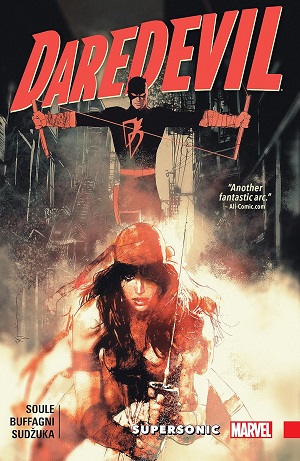 This volume is the sequel to Chinatown. Chinatown was so called because it was set in Chinatown. I’m not sure why this one is called Supersonic. It consists of three stories and the third one has Ulysses Klaw as a giant “kinetic living audio wave” so maybe that was it.
Charles Soule is the writer in charge again, though each of the three stories has a different artist. The last is illustrated by Vanessa R. Del Rey, who I last encountered in The Empty Man, where I said her drawing style was not my thing. I didn’t think it worked any better here. Her art just puts me off.
I didn’t care for the stories much either. The first has Daredevil battling Elektra, because she’s been brainwashed into thinking she had a child that Daredevil abducted. Weird. And it doesn’t go anywhere because her brainwashing is fixed and she just leaves at the end to find out who did it to her, and why.
The second story starts off well, with Matt Murdock crashing a high-stakes poker tournament in Macau. He’s able to beat a telepath because the telepath’s ability to “see” the other players’ hands doesn’t work with Murdock because he’s blind. That said, Murdock’s strategy of just going off of other players’ cues while not knowing any of the cards he’s holding himself doesn’t strike me as a likely winner. In any event, it turns out what he’s really after is a briefcase full of valuable information that he teams up with Spider-Man to steal. Again though I felt like things ended abruptly, leaving me wondering what the point was. Daredevil mentions how everyone has lost their memory of his secret identity but doesn’t say how it happened (you’ll have to wait for an explanation of that). Then Spidey warns him about going through a “black-costume phase” (like Spider-Man did), but even though Daredevil’s uniform has changed I haven’t got the sense that Soule was changing the character much. This isn’t dark Daredevil, or even dark-er.
Finally, the third story has Klaw turning New York into a city of sonic zombies. Daredevil and Echo (who is deaf) team up to stop him. And finally there’s a coda with long-time adversary the Gladiator descending deeper into criminal psychopathy.
I didn’t like any of this as much as I liked the Chinatown storyline. Blindspot shows up briefly in the fight with Elektra before being disabled. I like how Daredevil tries to protect him, recognizing when a challenge is out of his league. As happened when fighting the Hand in Chinatown. Overall I thought there were some good ideas here that just needed more development. The emphasis on action over plot is something I’m usually OK with in a superhero comic, but in this case I thought Soule was just coming up with hooks or concepts and not turning them into stories with any legs.
 Alex Good
Oh well maybe the next one will be better.
LikeLike
It was! The series was very up and down.
LikeLiked by 1 person
Was Soule working on multiple comics at the time? I know that can affect a writers output as they give their best to what interests them at the moment…
LikeLike
Absolutely! I think he was working on half a dozen titles at the time. A lot of comic writers are machines the way they pump stuff out.
LikeLiked by 1 person
And that is why we get such crap sometimes…
LikeLike
Yeah, but it’s always been like that for comics. Even in the golden age there was a lot of stuff that wasn’t very good just because they were an assembly line working to a brutal schedule to get issues out on time.
LikeLiked by 1 person
They should have read Groo!
LikeLike
So many lessons to learn from Groo . . .
LikeLiked by 1 person