
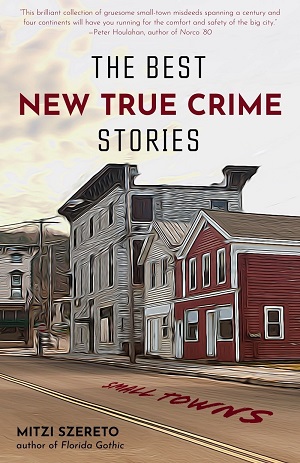
The Best New True Crime Stories: Small Towns
Ed. by Mitzi Szereto
The crimes:
“Snowtown” by Anthony Ferguson: a bank building in a dusty Australian town becomes the storage facility for the “bodies in barrels” serial killers, and subsequently becomes a dark tourism destination.
“A Tragedy in Posorja: When ‘People’s Justice’ Goes Horribly Wrong” by Tom Larsen: a lynch mob storms a police station in Ecuador, killing three people falsely believed to be child kidnappers.
“About a Boy” by C L Raven: in the 1920s a teenage boy kills a couple of little girls in a Welsh town.
“Twenty Cents’ Worth of Arsenic” by Edward Butts: a woman in a small town in Ontario is convicted of poisoning her husband.
“I Kill for God” by Mitzi Szereto: a mentally disturbed man goes on a shooting rampage in Washington state, killing six people and injuring several others.
“The Summer of ‘The Fox’” by Mark Fryers: a spate of home invasions and rapes terrorize the English town of Leighton Buzzard in the summer of 1984.
“Who Killed Gabriele Schmidt: The True Story and the Mystery Surrounding a Forgotten Murder” by Alexandra Burt: a young girl is killed in a town in central Germany.
“Bullets and Balaclavas: The Long, Cold Orkney Shooting” by Charlotte Platt: a teenager wearing a balaclava walks into a restaurant and kills the owner by shooting him in the head.
“The Black Hand and Glass Eye of Earlimart: A Killer’s Perspective” by Christian Cipollini: a hitman tells the story of his murder of a small-town drug dealer.
“Crime Has Come to Penal!” by Iris Leona Marie Cross: a brutal home invasion and murder in Trinidad.
“The Voodoo Preacher” by David Brasfield: in 1977 a minister is shot dead while attending a funeral in Alexander City, Alabama.
“La Bella Elvira: Murder in the Tuscan Hills” by Deirdre Pirro: a young woman is killed in postwar Italy.
“The Doctor, the Dentist, and the Dairyman’s Daughter” by Paul Williams: a young woman dies in a town in Wales and a local doctor is suspected of her murder in what might have been an abortion gone wrong in 1884.
“In the Home of the Cannibal” by Joe Turner: an aspiring cannibal advertises online for a willing victim, and finds one.
“Nameless in Van Dieman’s Land” by Stephen Wade: the 1996 Port Arthur massacre.
 The book:
As with a lot of these themed anthologies you’re led to ask what the significance of the connecting idea is, and how it might influence the way we think about crime in general.
In the present case, are these stories of small-town crime just meant to show the “dirty fingerprint,” in the language of Mitzi Szereto, on the “postcard images of picturesque town squares, parades down Main Street, bake sales, [and] church socials”? To reveal the dark side of places where it’s assumed “people look out for each other” and a time when “neighbor helped neighbor and people and property were treated with respect, and no one had to worry about locking doors”?
Well, Miss Marple had a thing or two to say about how crime and the universality of human evil undermines that vision of small-town life. I think we have to dig deeper.
So for starters, what is a small town? Does it depend on where the town is located? To take the first two stories, the current population of Snowtown, Australia is 356. The population of Posorja, Ecuador is 15,000. From what I could gather, they are very different communities. And it’s also the case that a lot of the crimes described here didn’t take place in small towns. Snowtown, for example, was only a place the killers stored the bodies of their victims, and many of the other killers we meet lived in homes outside of towns, in semi-rural areas.
We also span the globe in this book, with what are Australia’s two most notorious crime stories providing bookends, a couple of trips to Germany, one to Italy, two stories from Wales, a few set in the U.S., and some exotic locations like Trinidad, Orkney, and Canada also in the mix.
And what of the passage of time? Is the myth of the idyllic small town inextricably linked to “the values of the past, [and] the ‘good old days’”? Here as well the stories cover a lot of ground, being culled from headlines drawn from anywhere in the last century and a half. What does a small town in Wales in the 1880s have in common with a small town in Trinidad in 2018? Are small towns everywhere and at any time that much the same?
It’s an interesting question, but to be honest I don’t think it’s one this volume is all that interested in addressing. Instead, this is pretty much just a pot-pourri of crime stories characterized mainly by its geographical diversity. And that is in turn one of the more interesting connecting threads. The first story introduces us to the idea of “dark tourism”: the international rubberneckers of the true crime world. For the most part the towns here are not regular tourist destinations. I think Port Arthur might be the only place normal people would care to visit. But if you’re a reader of true crime and don’t like to travel you should enjoy this sampling of off-the-beaten path locales. If nothing else, you’ll learn a bit along the way about places you might not know anything about. I know I did.
Is dark tourism wrong? Years ago I remember my father and I going for a drive to see where Albert Johnson Walker lived in Paris (Ontario), but I think that was mainly because it was near where my father grew up. Most such places don’t have much to tell us though, or relate very much to the crimes they witnessed. The only stories where I thought place was really relevant were the lynching in Ecuador (with the background of that country’s indigenous justice movement), the home invasion in Trinidad (an island paradise that has become “a crime-ridden hellhole”), and the walk-through tour of Armin Miewes’s dilapidated farmhouse — or rather mansion (43 rooms?) — with Miewes’s pornography still left lying around years later. That struck me as weird.
Another connecting thread, and one less welcome, was the first-person voice adopted by many of the authors. I’ve mentioned before how much I don’t like this development, and how the “true crime memoir” is a sub-genre I avoid like a case of the clap. These stories don’t go that far, but many have a memoir flavour. To give you some idea of what I’m talking about, here’s a sampling of first lines:
I remember a sense of eeriness and palpable shame.
In 1984, as a six-year-old child, I moved to a small town in the South of England, where I would remain for the next twenty years.
We all have a story to tell about the summer of 1983: I was on vacation; I visited my grandmother; I took the train to Paris. I have told my very own story numerous times over the past thirty-seven years, a story that has morphed into the very reason I write about crime.
I had been temporarily resident in London, England, for eleven years and was fearful of returning to my home country.
It was a roasting Alabama day in June of 1977. I was three years old and living in a house down the street from the House of Hutchinson funeral home at the moment a vigilante shot Reverend Willie Maxwell in the face in front of two hundred mourners.
I went to this place as a tourist. I came away from it a true crime writer.
I wish non-fiction writers didn’t do this so much. In some very special situations it works, but most of the time I just want to say to them “It’s not about you.”
That said, I really enjoyed this collection. The international flavour (something that Mitzi Szereto’s anthologies tend to specialize in) was a plus, as was the fact that aside from a few of the more notorious cases, I wasn’t familiar with the crimes being discussed. Also, the fact that several of the crimes were either unsolved or their resolutions still open to dispute, added a bit of an edge. There were a couple of real clunkers, as you’d expect from a collection of what are all-new pieces, but overall the quality of the writing was pretty high.
Noted in passing:
In the story “Crime Has Come to Penal!” a married couple, along with the husband’s mentally ill adult brother, are brutally murdered (shot, throats slit) in their home. In the house at the time were the couple’s two children: a four-year-old girl and her infant (eight-month-old) brother. The rotting bodies of the adults were not discovered for four days, and in that time the little girl “cleaned the infant, changed his diapers, and bottle-fed him with milk from the open can that was found on the living room floor. She also gave him juice and snacks.” To be sure, both kids were in bad shape when they were discovered, but the girl did keep her brother alive.
That’s an impressive little girl! But the author points out that just a few months earlier a similar case had occurred in California, when a four-year-old girl cared for her two-month-old brother for three days following the murder-suicide of their parents.
Damn. Those are some resourceful four-year-olds!
Ranging as far afield as we do here, I picked up some proper geographical nomenclature. It is, for example, no longer considered correct to refer to the Orkney Islands as the Orkneys. The islands now simply go by the collective name of Orkney. I didn’t know that. I also didn’t know that residents of Trinidad and Tobago are known as Trinbagonians (or “Trinis” for short).
The bodies in the Snowtown case were put in barrels of hydrochloric acid, which didn’t have the desired effect of dissolving them but instead preserved them. Apparently what the killers should have used was sulfuric acid. The author chides them for being not too bright, but I would have probably made the same mistake. I’m not a chemist!
Takeaways:
When it comes to the violent expression of our basest emotions, human nature is pretty much the same everywhere.
 Alex Good
I’d forgotten about ‘The Fox’!
LikeLike
Every time I see the name Leighton Buzz’rd now I say to myself “Blimey! That’s the town what Fraggle’s bairn lives in!” And I do it in a proper accent too.
LikeLiked by 1 person
Haha.
LikeLike
He came from Sunderland too!
LikeLike
I was going to mention that part! Another Mackem gone bad.
LikeLiked by 1 person
That’s their default setting!
LikeLike
Must be a scary place to drive through!
LikeLiked by 1 person
It is, I have to Mad Max the 500 up when I go there.
LikeLike
Humans have an incredible survival instinct. It’s really amazing.
I suspect Miss Marple wouldn’t have made the same mistake about the acid as those guys….
LikeLike
Agatha Christie knew her chemistry, so yeah, Miss Marple was probably up on the difference too. Maybe once upon a time everyone would be expected to know the difference and we’re just losing it.
I think there was an episode of Breaking Bad that played on the different properties of the acids they used to dispose of a body but I can’t remember it now. And Walter White was a chemistry teacher so he doesn’t count as being representative of general knowledge.
LikeLiked by 1 person
I watched the first season of BB. at the end, I did not understand why the show became so popular…
LikeLike
I liked it. Last few episodes weren’t great, but series always seem to have trouble wrapping things up.
LikeLiked by 1 person
We liked the spin off Better Call Saul even more than BB.
LikeLike
I haven’t seen any of that but I’m looking forward to it. It takes me a long time to get through a cable series.
LikeLiked by 1 person
Glad you’re going to do it, it’s up in our top 10 best TV series.
LikeLike