Classics Illustrated: The Murders in the Rue Morgue and Other Tales by Edgar Allan Poe
 Many years ago I was visiting a friend who had a big collection of classical music on vinyl, including a recording of Rachmaninoff’s symphony loosely based on a translation of Edgar Allan Poe’s poem “The Bells.” The poem had been very freely translated into Russian, and the record jacket had helpfully re-translated it back into English. Which is to say, they hadn’t just reprinted Poe’s poem, which had originally been written in English, but had translated the Russian version back into English. I read it and, knowing “The Bells” by heart at the time (I couldn’t recite more than a couple of lines of it now) I couldn’t figure out what was going on. It seemed like “The Bells,” but wasn’t. It took me some time to figure out what was going on. Why translate a poem written in English, into English?
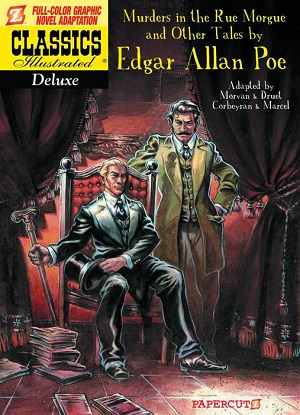
I was reminded of that incident when reading this graphic adaptation of three of Poe’s mystery tales. It’s part of the Papercutz relaunch of the Classics Illustrated imprint, but is actually a translation of French versions of the stories. So the translator gets a credit, which I think he deserves, even though he’s translating what was originally a story written in English back into English.
It’s not true that the French discovered Edgar Allan Poe, but he was popular with the literary crowd there at a time when he was seen more as a novelty act in America. Part of the appeal might have been, as was suggested by some critics, that he read better in translation, the most influential of his translators being the poet and critic Charles Baudelaire. Jean David Morvan, who wrote the versions of “The Murders in the Rue Morgue” and “The Mystery of Marie Rogêt” included here, gives thanks to Baudelaire for his “brilliant translations” in the prefatory material. So as with the album of Rachmaninoff’s symphony things have come full circle.
The three stories here are, in order, “Murders in the Rue Morgue,” “The Gold Bug,” and “The Mystery of Marie Rogêt.” The first and last feature the detective C. Auguste Dupin and are written by Morvan and illustrated by Fabrice Druet. Instead of presenting “The Purloined Letter,” the third Dupin story, “The Gold Bug” is the odd story out, and it’s written by Corbeyran and illustrated by Paul Marcel.
The two Dupin stories are presented in very similar ways. Even their openings, with silent montages revealing the murdered bodies, are nearly identical. After such promising beginnings though things settle down to rather literal transcriptions of the story. The art works hard to mix things up, especially in “Marie Rogêt,” but I just found the pace plodding, with far too much text. I honestly don’t know why they included “Marie Rogêt” at all, since there’s no dramatic action and the “story” is really just a dissection of the case (the Mary Rogers case, out of New York) as reported in various newspapers. When I recently re-read it I had a hard time finishing it, and the graphic version wasn’t any easier.
As a final note on these two stories, I guess we all imagine fictional characters appearing in different ways. And given that I don’t think there is much in the way of a physical description of Dupin in the stories (unlike Holmes, Poirot, and Nero Wolfe, who we could all probably recognize walking down the street), readers have a lot of leeway in forming their own mental portrait. My own idea of Dupin and the narrator has them as a couple of middle-aged oddballs, a bit stuffy and with an air of the antique about them. Here they’re a pair of dashing young bucks, and I had trouble getting sorted who was who. In fact, there was a point in the first couple of pages where I’m sure the names had gotten mixed up because Dupin addresses the narrator character as Dupin. But since they both looked kind of generic it didn’t make much difference.
“The Gold Bug” is something else, at least visually. Paul Marcel has a dedication to Richard Corben (who has done his own Poe adaptations), and you can see some influence at work. But the swirling tendrils of water, smoke, flame, and forestry give everything a unique organic feel, and Legrand’s pointy horns of red hair give him a suitably demonic appearance. Like the other stories it suffers a bit from pacing, getting bogged down in Legrand’s explanation of his code-breaking, but overall I enjoyed it.
Poe has been illustrated in memorable ways for nearly two centuries now. I have half a shelf of examples in my own library. But there is a difference between illustrating Poe and turning him into a comic. These stories in particular don’t seem that well suited to being adapted. I like the art, but it just feels like they were struggling to get as much of the original story in as possible, with results that are often awkward, poorly paced, and even hard to follow. I like the Classics Illustrated brand, but these newer versions are kind of hit and miss. At least they’re trying though.
 Alex Good
Christopher Plummer Is Julian Sands as the man with the stick, Peter Saarsgaard is Harvey Keitel as the man with the goatee, and when these dudes get together with Sophie Ellis Bextor as Marie Roget, it’s MURDER on the Rue Morgue Dancefloor!
I think you’ll find that Poe adapted Goldbug from this original song.
LikeLike
That’s definitely casting against the grain. Might have worked better than this. I always thought of Dupin as looking more like Rumpole.
LikeLiked by 1 person
Rumple never looked like he was going to Comic Con as Dr Strange like these guys do. Real Dr Syn vibes.
LikeLiked by 1 person
That’s why these guys are pretenders! They look too dandy. Like something out of one of those trashy pirate novels Booky likes . . .
LikeLiked by 2 people
Unless there is a picture on every other page, these are not the Classics Illustrated I grew up with!
LikeLiked by 1 person
CI was a popular comic brand! Didn’t you read them when you were a kid?
LikeLiked by 2 people
Ahhh, I was getting this confused with “Great Illustrated Classics “
LikeLike
Got it. I had the Classics Illustrated War of the Worlds and Last of the Mohicans as a little guy. Wore them out reading them.
LikeLiked by 1 person
Nope.
LikeLike
Ah, well. Will be heading off to Leighton Buzzard next month in the True Crime Files. Maybe that will interest you.
LikeLiked by 2 people
I’m going there in June myself!
LikeLike
Actually I was kidding. Sort of. I’ll be heading off to Buckingham. And I didn’t know where Buckingham was so I pulled up a map and I noticed it seemed pretty close to Leighton Buzzard. And I said “Cor, that’s where Fraggle’s bairn resides!”
LikeLiked by 2 people
About a half hour drive from where the Bairn lives. Never went there when I lived in LB though.
LikeLike
Doesn’t seem very big. All these places are a lot closer to London than I thought they were.
LikeLiked by 1 person
Didn’t go there very often either.
LikeLike
Probably not much to see or do.
LikeLiked by 1 person
There’s loads! Some great architecture and museums, I did go a little bit!
LikeLike