
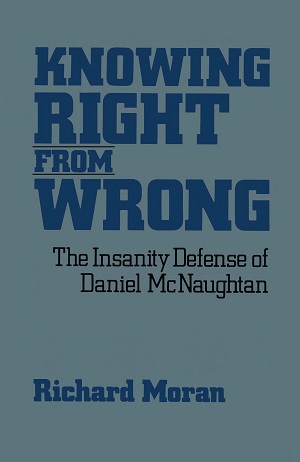
Knowing Right from Wrong: The Insanity Defense of Daniel McNaughtan
By Richard Moran
The crime:
In January 1843 a disgruntled Glaswegian named Daniel McNaughtan killed Edward Drummond, private secretary to Prime Minister Robert Peel, by shooting him in the back. Apparently McNaughtan mistook Drummond for Peel. At trial, McNaughtan was found not guilty by reason of insanity and sent to a mental hospital for the rest of his life. There was an outcry against the verdict, which resulted in the formulation of the long-lived McNaughtan Rule: that a defendant could only be found guilty if, at the time of his criminal act, he was suffering from such a disease of the mind that he could not appreciate the nature or quality of his act, or that if he did not know that what he was doing was right or wrong.
 The book:
This is a short book, but it reads like a long one. I don’t mean that in a bad way, to suggest that it’s boring. It’s just very focused and dense. If you have an interest not only in legal history but in early Victorian issues like Chartism and the Anti-Corn Law League then you’ll enjoy all the detail, but these are complicated matters that I think assume some familiarity with the period on the part of the reader. And then there’s more background provided in the extensive appendixes, which even include a transcript of the House of Lords debate on McNaughtan. If you’re like me, you’ll be taking a lot of notes.
Mainly however the book provides a very full accounting of the case itself, and one that Richard Moran gives a significant revisionist spin to. Some indication of where things are heading comes with the dedication: “To the young Scotsman from Glasgow whose search for political and social justice brought him face to face with the ultimate question of right and wrong.” That young Scotsman (actually he was 30 years old, which I don’t think was young by Victorian standards) would be Daniel McNaughtan.
The first point Moran makes is that McNaughtan wasn’t crazy. Indeed, nobody thought he was crazy at the time. Even Queen Victoria (who was sensitive on the subject after having being recently targeted twice by assassins) thought the idea absurd, writing in her diary that McNaughtan was “clearly not in the least mad.” Of course, the understanding of what it meant to be mad was a little different in her day. The then current theory of mind had it that the brain had two compartments: one for intellect and the other for the “moral faculties.” Thus it could be argued that McNaughtan’s moral faculty, the ability to properly distinguish between right and wrong, was impaired while his intellect was still functioning. As for evidence of such impairment, at trial it was argued by his defence lawyer that his love for children and habit of feeding pigeons in the park were “early indicators of a ‘predisposition to insanity,’ portraying the former as a peculiar delight in the ‘innocent ways’ of children and the latter as an odd ‘humanity toward the brute creation.’” Also suspect was his “custom of bathing daily in the nearby river Clyde.” This was said to relieve “the torturing fever by which his brain was consumed.”
None of this strikes a twenty-first century ear as very persuasive, and it’s hard to disagree with Victoria’s common-sense understanding of the matter. But if McNaughtan wasn’t crazy, why was he trying to kill the prime minister?
For Moran it’s clear that McNaughtan’s actions were politically motivated. Which is in fact what McNaughtan claimed they were: a way of fighting back against the persecution he felt he had suffered at the hands of the ruling Tories. So why then did his case become the leading case for over a century on the issue of mental illness and criminal responsibility? Because the political administration wanted it that way. This is where the really revisionist part of Moran’s book comes in to play. “The time has come to challenge the conventional wisdom concerning the McNaughtan case. Far from representing an enlightened humanitarian view of criminal responsibility by a judge and jury concerned with the welfare of a mentally ill defendant, the verdict in the case was mainly the result of political considerations.”
In a nutshell, McNaughtan claimed he had been harassed and persecuted by the Tory government, and there may have been some merit to the charge. But for the Victorians being anti-government was itself a form of madness. At least that’s the way it was seen in establishment circles. Only a few days after McNaughtan’s trial one John Dillon was arrested for threatening to shoot the chancellor of the Exchequer. Upon his arrest he declared that at his trial he would “not plead insanity, but injustice.” But as Moran notes, “The very act of threatening violence against a public official was sufficient for the Victorians to view Dillon as insane. Even the knowledge that his complaint was legitimate did not alter their opinion of his mental condition.” But there was an even stronger argument for proceeding against McNaughtan the way the Crown did:
Beyond serving the purpose of prolonged incarceration [there is no fixed sentence for those found criminally insane], the insanity verdict can function to deter potential political offenders. It was not necessary for the Tories to execute or imprison McNaughtan in order to discourage others from committing similar crimes. All that was necessary was to make him unattractive as a role model. The insanity verdict accomplished this in the most effective manner. By defining McNaughtan’s crime as outside the realm of human reality, the insanity verdict neutralized him as a model for others. While there was at least some disagreement over the desirability of assassinating the prime minister, there was virtual agreement that mental illness was undesirable. The insanity verdict robbed McNaughtan of his political credibility and negated the symbolic and instrumental aspects of his crime. In this sense it was a much greater penalty than death. The impossibility of having one’s political message properly understood must remain the most powerful deterrent to political murder.
The world would be made safe then through a process of judicial labeling. McNaughtan wouldn’t be a martyr to a cause but politically neutered by being locked away as a nut.
But Moran doesn’t stop there. He doesn’t leave it that McNaughtan was politically motivated and not insane. He goes a step further and argues that McNaughtan was, or at least might have been, justified. This is quite a radical step and it’s worth quoting Moran at length here:
Instead of searching for the pathological motivation in McNaughtan’s mind, we might ask how so many of his countrymen who shared his political perspective and proscriptive analysis stood by and watched as their families and friends suffered from the effects of political and economic exploitation. The important psychological dimension requiring explanation might well be the capacity of so many people to deny quietly the desperate political realities of early Victorian England.
The acknowledgment of assassination as a political weapon is a difficult notion for most people to accept. It violates our social and political norms, causing many of us to adopt the extreme position that political murder can never be justified. Still, when confronted with the specter of Adolf Hitler, most people concede that his assassination would have been a morally acceptable act and his assassin a person deserving of considerable praise. It is often said that in a democracy there are other ways to express dissent, that violence is not the way to influence the course of government, that political influence is exerted through elected officials. Regardless of the possible validity of this point of view, it must be recalled that early Victorian England was not a democracy but a constitutional monarchy. Much of Peel’s political life had been devoted to preventing England from embracing representative government. As a Chartist committed to universal suffrage, McNaughtan could not be expected unconditionally to honor the political rules laid down by an aristocratic government to ensure its hegemony. It makes little sense to suggest that McNaughtan should have continued his futile effort to vote Peel out of office, especially since Peel, a staunch defender of the corrupt boroughs, had repeatedly ridiculed the attempt by the working classes to petition Parliament for the right to vote.
What is at issue here, however, is not whether McNaughtan was justified in attempting to assassinate Peel, but whether the intention to do so was inherently irrational or illogical. A definite distinction must be made between the two. McNaughtan’s belief that Peel’s death would have a positive effect on Britain was not a “peculiar notion” he alone entertained.
From here, Moran argues for allowing defendants, in narrowly defined circumstances, to argue for the political or moral justification for what are admittedly criminal acts. This is not meant as a “get out of jail free” card for social justice warriors of whatever position on the political spectrum, but is instead put forward as an alternative to mislabeling as madness what are political acts; a mislabeling that is itself political.
Noted in passing:
Drummond didn’t die right away but took five days to expire, after the best doctors in England did what they could do hasten him along with excessive bloodletting through the application of leeches. Was there ever a more Victorian passing than this?
On Wednesday morning Edward Drummond was informed that he had less than an hour to live and that he must now put his trust in the Lord. Drummond’s reply was characteristically stoic: “The sooner the better – I don’t feel pain.” Turning to his sister, who was sobbing by his bedside, he said: “We have lived long and happy together, and my only regret is in parting with you.” With a faint smile he added: “That ugly French word malaise expressed most fully my burden.” After taking a sip of wine mixed with potassium water, Edward Drummond, a bachelor whose entire adult life had been devoted to public service, died in the arms of his maiden sister.
Takeaways:
You don’t have to be crazy to want to kill someone.
 Alex Good
I bathe in the River Clyde every day, and am yet to see any ill effects. What are you trying to say?
Yours
A Disgruntled Glaswegian (there are no other varieties)
LikeLike
I imagine the Clyde is a little chilly this time of year. Is your brain consumed with a torturing fever? Do you feed pigeons in the park? We may need to stage an intervention.
LikeLiked by 1 person
It depends if you’re in the deep bits or not; some of it has been dredged to allow larger ship down. I’ve raced zap cat boats on it too.
So if I want to kill a political figure, then I must be mad, and that’s demarcation is designed to stop anyone from trying to do it? Is that the gist? Are you aware of the Monster Raving Looney Party? What if I wanted to kill one of them?
LikeLike
I’m pulling a blank on a zap cat boat and am afraid to Google it.
You have the gist of it correct. But the information on this website does not constitute legal advice relevant to any jurisdiction or historical period.
LikeLike
Well for once a canny rather than pesky Scot.
LikeLiked by 1 person
But he didn’t end well.
LikeLiked by 2 people
No, but at least he tried!
LikeLike