
Evidence of Things Seen: True Crime in an Age of Reckoning
Ed. by Sarah Weinman
The crimes:
“A Brutal Lynching: An Indifferent Police Force, a 34-Year Wait for Justice” by Wesley Lowery: the cold case murder of a Black man in Georgia is solved simply by following up reports of how one of the killers had been bragging about it for years.
“The Short Life of Toyin Salau and a Legacy Still at Work” by Samantha Schuyler: a Black activist is killed in Florida and the police don’t seem to care very much.
“‘No Choice but to Do It’: Why Women Go to Prison” by Justine Van Der Leun: some women may only be guilty of “acts of survival.”
“The Golden Age of White-Collar Crime” by Michael Hobbes: it’s never been a better time to be a corporate scofflaw.
“Picturesque California Conceals a Crisis of Missing Indigenous Women” by Brandi Morin: there’s a need for better reporting on and police investigation of MMIWG.
“How the Atlanta Spa Shootings – the Victims, the Survivors – Tell a Story of America” by May Jeong: pocket bios of the victims and survivors of the 2021 Atlanta spa shootings, who were mainly Asian immigrants.
“Who Owns Amanda Knox?” by Amanda Knox: after becoming an unwilling focus of the media as well as the Italian judicial system, Amanda Knox considers the alternate life of her celebrity.
“Tie a Tourniquet on Your Heart: Revisiting Edna Buchanan, America’s Greatest Police Reporter” by Diana Moskovitz: a Miami true crime writer turns out to have been more a person of her time than a pioneer.
“The True Crime Junkies and the Curious Case of a Missing Husband” by RF Jurjevics: a woman’s Facebook post about the disappearance of her husband triggers an Internet investigation that turns up a darker story.
“Has Reality Caught Up to the ‘Murder Police’?” by Lara Bazelon: the Baltimore homicide detectives who inspired David Simon’s creations Homicide: Life on the Streets and The Wire turn out to have had a less than stellar track record.
“Will You Ever Change?” by Amelia Schonbek: inside a program that pairs survivors of domestic violence with surrogate offenders for therapeutic dialogue.
“The Prisoner-Run Radio Station That’s Reaching Men on Death Row” by Keri Blakinger: a radio program is broadcast very locally out of a Texas prison.
“To the Son of the Victim” by Sophie Haigney: a reporter recalls her brief interaction with the son of a shooting victim.
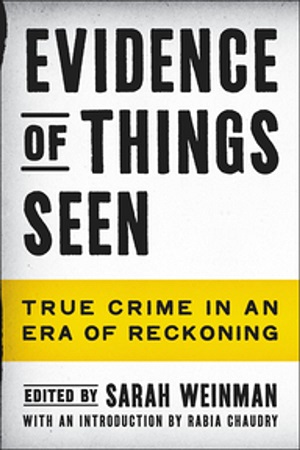 The book:
Well, if that “age of reckoning” didn’t give it away then I’ll give it you in a word: this is an anthology of woke true crime.
I don’t mean that in a bad way. What editor Sarah Weinman has wanted to do (here and in her earlier anthology Unspeakable Acts, to which she considers this to be “a companion volume and an extension”) is to expand on the popular understanding of “true crime” to bring in less familiar elements and storylines. In particular, she sees this collection as “a testament to the discomfort we live in, and must continue to reckon with, in order to hold the true crime genre to higher ethical standards and goals.” Whew! That’s setting a high bar. Does the book deliver?
Things get off to a bad start. The Introduction is by Rabia Chaudry of the podcast Undisclosed, and she duly brings the killing of Hae Min Lee up, patting herself on the back for clearing Adnan Syed. This is a case that still divides people though, and I personally lean toward thinking that Syed was at the very least involved in Lee’s murder. Chaudry herself has also been the target of some fair criticism for her advocacy and I can’t say she’s a voice I trust very much. Her Introduction also wrong-footed me from the get-go: “The debate about whether the true crime genre, across all forms of media, does more harm than good in society is long-standing and contentious.”
A long-standing debate? Sure there have been critiques of true crime, but Chaudry’s evidence for a debate is pretty thin, or what the grounds of such a debate might be. A couple of sources are quoted for the claim that consuming true crime content is bad for us, but then these are quickly dismissed. A tone is set of looking for an argument, even when none is available.
One point Chaudry brings up is worth flagging though because it plays an important part in several of the stories to come. This is the critique that “monsters like Ted Bundy and Jeffrey Dahmer have left permanent marks in pop culture while their victims have been forgotten.” There’s nothing new in this observation and it’s been given a lot more play in the demand for new perspectives not just in true crime reporting but in every facet of our culture, perspectives that seek to tear down the celebrity of (typically white male) villains while prioritizing the stories of their victims.
This is a moral position to take, and also one that very much feeds off of the priority given to victims, however broadly defined, in our culture. Perhaps the most prominent recent example of this in the context of crime reporting was New Zealand prime minister Jacinda Ardern’s refusal to name the perpetrator of the Christchurch mosque shootings and her urging others to “speak the names of those who were lost rather than the name of the man who took them. He may have sought notoriety but we, in New Zealand, will give nothing – not even his name.” This is a directive heeded by May Jeong in her piece here on the Atlanta spa shootings where the killer (Robert Aaron Long) is only referred to as “the suspect” while the reporting itself is almost entirely given over to pocket bios of the people he killed.
This is not just a moral position to take – most killers are monsters and their victims innocent – but it’s also one that has a political argument behind it as well. Should the media broadcast or even make available the manifestoes of mass killers like Elliot Rodger, Anders Breivik, and Brenton Tarrant? A fair question. In a culture like ours, where celebrity is the coin of the realm, there’s something wrong about using one fame or notoriety to promote hate. At the same time . . . it is the coin of the realm. This is something everybody understands. Theodore Kaczynski by his own admission became the Unabomber because he knew it was the only way he could get people to pay attention to his manifesto.
That said, I don’t think true crime writers, or the genre in general, make heroes out of wrongdoers. But the matter of celebrity and what gets our attention leads to a further point. We read true crime because it deals with the exceptional: the pathologies of human nature and behaviour. We don’t read about serial killers because we admire them but to learn something about them, like what went into making them and how they can be identified. Meanwhile, what can be learned from their victims, who are all too often simply people who found themselves in the wrong place at the wrong time? It’s not that we don’t care about them, it’s just that they’re normal, and we’re not that interested in normality.
But while defensible on some levels, I think there are serious caveats to be entered when reading true crime that comes at us from the margins, as woke or victim-based.
In the first place, and I’ll use Jeong’s piece as the test case, it’s writing that has an agenda and it can strain too hard to score political points, occasionally becoming tendentious in the extreme. Here, for example, is a description of Long’s hometown:
Woodstock, Georgia, was Cherokee country before its original inhabitants, who had been in the area for 11,000 years, were displaced by white settlers around the mid-1700s. On May 28, 1830, President Andrew Jackson signed the Indian Removal Act, codifying into law the forcible removal of 15,000 Cherokee people from what is today their namesake county. The white settlers panned for gold in nearby rivers, purchased Black people as slaves, and opened chicken processing plants, still in operation nearly two centuries later.
Woodstock today enjoys a median family income of $76,191, and is almost 80 percent white. It is the hometown of at least two notable figures: Dean Rusk and Eugene Booth. Rusk, who later became secretary of state, was responsible for splitting the Korean peninsula in two using a foldout map from a copy of National Geographic. The line “made no sense economically or geographically,” he later admitted, but it allowed American occupying forces to take control of Seoul, a decision that would divide families for generations. Booth was a nuclear physicist and core member of the Manhattan Project, which led to the bombings of Hiroshima and Nagasaki in Japan, killing as many as 250,000 civilians, according to some estimates. Woodstock is proud of their native sons, naming a middle school after Rusk.
What is the point of all this? Does Jeong not eat chicken? How personally responsible was Dean Rusk for the division of the Korean peninsula? Where was he supposed to draw the line on the map? Should Seoul have been given to North Korea? Was Booth wrong to work on the Manhattan Project? What does the dislocation of native tribes from Woodstock 200 years ago have to do with Long’s motives? Is it just meant to be taken as being all part, somehow, of the same racist, imperialist matrix?
Second, does the erasure of the killer’s name make this a better piece of reporting? Does it add something by subtraction? It’s hard not to feel like we’re reading an ideologically cleansed version of the first draft of history here. And it’s the sort of policy that goes beyond true crime reporting. There are no Wikipedia pages, for example, for Elliot Rodger, Brenton Tarrant, or Robert Long but only for the 2014 Isla Vista Shootings, the Christchurch mosque killings, and the 2021 Atlanta spa shootings respectively. I think that must be part of the site’s editorial guideline. Is it justified? And finally there’s the fact that Jeong’s article on the shootings is 25 pages long, providing biographical sketches of six of the seven women killed and of the one man, an immigrant from Guatemala, who was injured but survived the attack. Jeong also has a couple of pages where she talks about her own Korean-American family. The one man who was killed, along with the other woman, have their names mentioned briefly in a single paragraph together. They were the only two white victims. This isn’t a full story or accounting then. But what kind of a story is it?
Third: I don’t think it should make a difference where the author is coming from. I prefer most true crime writing that adheres to traditional standards of objectivity, and (as I’ve said before) there are few things I despise more than the trend toward “true crime memoir.” But this sort of writing, which often plays up group identity, invites authors to stake their writing in their own experience. And so Jeong adds that section I mentioned on her own family’s American experience as Korean immigrants, and Mallika Rao does the same while writing on an Indian family in Texas.
I understand Rao’s point, that Texas cops don’t understand something that she does just “by virtue of being born to Hindus in Texas,” but how far can we take this? Rao mentions how the defence counsel for the mother accused of killing her child was going to call an expert witness to say that the defendant “had all the markings of a truth teller, a woman in grief.” But Rao doesn’t “need an expert to tell me that. I felt it just by watching her.” Because of some cultural fellow feeling? Superior empathy? Then only two pages later she takes the trial transcript to task for using the word Hindu instead of the correct Hindi to describe the language the accused was speaking in. “As I saw that repeated typo, I wondered if the error had been the court reporter’s or if it had been spoken by those in charge of Pallavi’s fate, in that courtroom. I wondered how much of any case is built and tried on fact and how much on feeling, instinct. No one in the court had been of Indian origin except the defendant and her husband.”
Is this an injustice? Are the only feelings and instincts that can be trusted those of individuals from the exact same cultural background or ethnic identity? Should all true crime writing become a form of memoir, a personal identification between the author and the victim (never, of course, the perpetrator of violence)?
And what if the roles are flipped from the usual script? How are we to handle the “True Crime Junkies” story, where the villain of the piece is a predatory woman who destroys the life of an innocent man? Should we say her name? Should we be more interested in telling his story? What would we learn from that?
So I did have some caveats. But this is a nice anthology with some good stories in it and some fine writing. I found the piece on white-collar crime, the one by Amanda Knox, and the True Crime Junkies story, to be particularly thought-provoking. And even Jeong’s take on the Atlanta killings was quite good, only needing six or so pages taken out of it. But in the final analysis I’m not sure the case was made for this being representative of true crime writing that’s setting “higher ethical standards” or even providing more truthful (fuller? more objective?) accounts. Instead, what it highlights is the fact that every piece of writing, of whatever genre, comes from a particular point of view, if not with a full-blown agenda.
Noted in passing:
The essay by Lara Bazelon on how the writer and show runner David Simon presented an airbrushed picture of the Baltimore police in his 1991 non-fiction book Homicide: A Year on the Killing Streets (which in turn led to the NBC series Homicide: Life on the Streets and the HBO show The Wire) struck a familiar note with me. Simon had followed a group of Baltimore homicide detectives around for a year but hadn’t reported on any of their misdoings, a pattern of conduct that would lead to many ruined lives, overturned convictions, and tens of millions of dollars in judgments against the city.
Was this inevitable? A former head of the Baltimore Innocence Project calls the book “a cautionary tale for embedded journalism.” Simon’s collaborator Richard Price, in a foreword to a later edition of Homicide, asked “Are writers like us . . . who are in fact dependent in large part on the noblesse [what an odd choice of word] of the cops to see what we have to see, are we (oh shit . . . ) police buffs?”
I think Price is letting writers off easy by calling them fans in such a case. As journalists covering war zones have been pointing out for decades now (Robert Fisk was one of the most outspoken), being “embedded” with the military puts one in a hopelessly compromised position. Indeed, the whole point of embedded journalism, and I think the term was first used with regard to media covering the first Gulf War, was for the army, and the state more broadly, to control news coverage. What nobody (or at least nobody working for the military) wanted was “another Vietnam.” The army wasn’t letting reporters be embedded for altruistic reasons but rather as a way of co-opting their voices and controlling the coverage.
The reason this had a particularly familiar note to me though has regard to a different context. As I’ve written on at length in other posts (please see here, here, and here), reporters and biographers writing about living figures who are given special or exclusive access to their subjects are always compromised. Access comes with strings attached. If you’re going to write about the armed forces, or the Baltimore police, or some celebrity, no matter how minor, and they let you follow them around or give you an interview, it’s because they are looking to shape the narrative and are expecting you to follow their ground rules. It’s a symbiotic relationship, with the writers as parasites that are only allowed to function if they perform some useful task for the host.
Takeaways:
Perspective matters when it comes to the writing of true crime, and changing things up does add a lot to our understanding of matters relating to the criminal justice system. However, not all that a different point of view adds is helpful or instructive, and it’s also the case that sometimes something can be lost.
 Alex Good
I’m uneasy with true crime of any period, for the reasons you discuss; I prefre to see a fictional take, firmly within the realms of fiction, than attempting to get close to real life subjects. We probably remember the names of Ed Gein or Peter Sutcliffe better than the novellists, movie or pop stars of their day, and that’s a problem. If we remember the killers and not their victims, what message does that send out going forwards?
LikeLike
There have always been people who have been famous for being evil. It seems we’ve thrown in the towel though in saying that celebrity is an absolute good and that we can’t talk about bad people or mention their names because that is to valorize them or make them into heroes in some way. Not mentioning the names of serial killers strikes me as being excessively politically correct. You can imagine where that kind of thinking leads you (by the same logic, histories of Nazi Germany should only refer to “the German dictator”). Reporters and historians should be able to present all the facts of a case without that kind of editorial filter.
LikeLiked by 1 person
I don’t read or watch true crime stuff but obviously see the ones that get in the newspaper, I am not sure if that’s more impartial.
LikeLike
I think newspapers still try most of the time to report the basic facts, the who, what, where, and when.
LikeLiked by 1 person
That’ll do for me I think, though the odd ‘based on’ movie has crossed my path.
LikeLike
Anyone who tries to censor facts (names, situations, etc) is the evil one in my books.
LikeLike
It’s taking having an agenda too far. This is not the kind of thing non-fiction writers should be doing.
LikeLiked by 1 person
Maybe you should start a podcast and excoriate people like this? It’d bring in the revenue….
LikeLike
Maybe someday. But . . . probably not. I think those podcasts are actually a lot of work, even when they seem like they’re not.
LikeLiked by 1 person
Yeah, podcasts are a TON of work. You’ll never catch me doing one….
LikeLike
I was amazed to hear one guy a year or so ago who hosted a podcast I sometimes listened in on talking about the business side of it and saying he had a staff of 14 full-timers. And he was basically just a guy talking in his office. I think there are a lot out there like that. They just seem like some rando with a cam splicing some video together but they’re a big business.
LikeLiked by 1 person