
The Forever Witness: How DNA and Genealogy Solved a Cold Case Double Murder
By Edward Humes
The crime:
In 1987 a pair of young Canadians, Jay Cook and Tanya Van Cuylenborg, were killed on a trip to Seattle to pick up a furnace part. Over thirty years later William Earl Talbott II was convicted for their murder, having been caught by the new science of genetic genealogy.
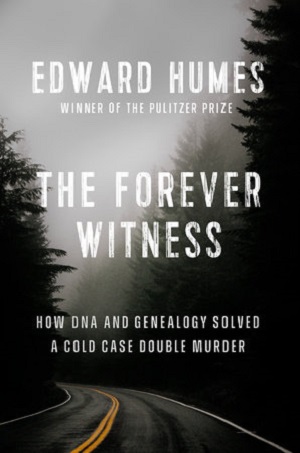 The book:
This is a great book, both for how well Edward Humes tells the story – offering different perspectives into the killing and subsequent investigation – and for the importance of what it tells us about modern forensics.
The basic elements of the crime weren’t exceptional. Jay and Tanya were a normal couple whose only mistake was being in the wrong place at the wrong time. That place being the state of Washington, a.k.a. Ann Rule country. “In the 1970s and 1980s (and continuing through the 1990s), Seattle and the Pacific Northwest had become home to an extraordinary number of serial killers, rapists, and killers.” Among the lowlights we find names like Ted Bundy, Gary Addison Taylor, Gary Ridgway, and Robert Lee Yates. I’m not sure why this should be. Humes says that “from a practical standpoint, the region served as a predator’s ideal habitat” because Seattle “was a big city . . . surrounded by . . . extensive woodlands and wild areas.” But I don’t think the urban or natural environment has much if any influence on the creation of a serial killer. And Talbott was, somewhat surprisingly, not a conventional killer. A moody child who tortured animals and then escalated to extreme and methodically planned violence, you would have thought he’d go on to a bloody criminal career. But apparently Jay and Tanya were a singular outburst.
In any event, Seattle wasn’t the place to be visiting in 1987. But Jay and Tanya’s fate, like most such tragedies, was the product of contingency:
so many other factors contributed to what happened, so many seemingly inconsequential events and decisions. They all had to occur just so and in precise sequence, like a once-in-a-lifetime alignment of the planets, without which Tanya and Jay’s trip wold have concluded uneventfully and there would have been no BOLO [a “be on the lookout” advisory], no manhunt, no case at all. First there had to be a broken furnace on Vancouver Island. Then a usually reliable Canadian heating supply company had to fall through, and a Seattle supplier had to have just the right vintage furnace and parts. There had to be a customer who needed that installation before the weekend and a business partner who could not make that happen. Jay had to have just lost a job so he had time to go to Seattle, and Tanya’s best friend had to be sick so she could not come and provide strength in numbers. The travelers had to reject a simple, foolproof route in favor of a complicated scenic course where a wrong turn was practically inevitable. Jay and Tanya had to arrive in Bremerton hours late, yet in time for the last ferry to Seattle. Omit or change any one of these links in the chain of events, and the couple from Vancouver Island would never have reached the same spot at the same time as a stranger determined to do evil.
Perhaps because Talbott was such an oddity and the murders a one-off, and perhaps because of the unfortunate series of accidents leading up the killings, the case remained cold for a very long time. But then came what Humes refers to as the third revolution in DNA profiling: snapshot DNA phenotyping (generating an image of a suspect based on their DNA) and even more significantly genetic genealogy.
Humes provides a good backgrounder on the history of the science behind genetic genealogy. Basically it means identifying a source of DNA by using vast online genealogy databases. Previously, using DNA “fingerprinting,” you could only match DNA found at a crime scene with the individual who shared the exact DNA – that is to say, the very person the police were looking for. If that individual’s DNA wasn’t already on file somewhere as a previous offender, you were out of luck. With genetic genealogy investigators could drill down to virtually any individual by way of their family DNA. It wasn’t even that hard. What was originally thought impossible turned out to be simple. It took CeCe Moore, the DNA detective on this case, only a couple of hours sitting on her couch at home with her laptop to identify Talbott, an individual with no prior record.
It all sounds like science-fiction. When combined with the snapshot image generator it’s even a bit like Minority Report. But there’s no denying it’s effectiveness. What concerned people was the potential for misuse in such a technology. Who had the right to such information? What could they do with it?
I’ve always had two responses to these concerns. In the first place, the toothpaste is out of the tube. Now that we have the technology available, we’re going to use it. Or at least somebody’s going to use it. And how and why did things get to this point? Not because of governmental overreach but because we voluntarily gave up all this information. I’ve never understood why people complain about the government invading our privacy when we’ve been more than willing to let private companies invade it even more. I’ve gone on about this before, and had made notes to say more on the subject here, but at the end of the book Humes himself says it better and he’s worth quoting at length because this is important:
Focusing on law-enforcement use of DNA databases as a major threat to privacy is like regulating matches in order to address the problem of rampant wildfires. Attention is being misplaced – or diverted from – much larger potential threats to privacy and democracy.
While we obsess on what the police are up to when ferreting out a few names and emails from public genetic databases, millions of Americans are blithely uploading their complete genomic information to largely unregulated private profit-making companies who monetize customers’ precious, extremely valuable DNA in a multitude of ways, including highly lucrative biomedical research. And, rather incredibly, the DNA donors are paying these companies to do it.
More than forty million people had taken a consumer DNA test by the end of 2021. That’s nearly double the number reached in 2018. What the police can access in their searches is nothing compared to the vast information these millions of customers are giving to the private companies. It may go out the door as just a tube of spit in the mail, but to these companies, your spit is liquid gold from which your most sensitive, private self and secrets can be extracted: Are you prone to heart disease? Cancer? Alzheimer’s? Mental illness? Depression? Do you have children with more than one spouse? Are you adopted? Are you related to a criminal?
People are giving away the keys to stuff even they may not know about themselves to profit-making companies who answer only to their shareholders. And the information you turn over to these corporations also informs them about your children and your parents and your other close relations – everyone who shares your DNA. You might as well send them your diary, your checkbook ledger, and your tax returns. But all the critics want to talk about is what the police are going to do with those names and emails they extract while hunting for serial killers.
It would only take one Enron of DNA, in an otherwise respectable industry – or one well-lace database hack of companies whose vulnerability has already been demonstrated – to cause more damage than anything imagined by those who worry about cops using genetic genealogy. What would the data be worth to an insurance company looking to deny coverage? To companies looking to screen their potential hires? To lenders and underwriters who make millions for every fraction of 1 percent of risk they can avoid? What would sensitive private information be worth to political operatives, domestic and foreign spies, to those who would blackmail leaders or manipulate and game an election? And the DNA doesn’t have to be from the person being coerced. Malefactors can get to them through a cousin. Or an aunt. Or a child.
It’s painful when your credit card is hacked. But you can cancel it and get a new one. Once your genome is hacked, there’s no undoing it. It’s the only one you’ve got.
There is much here that needs to be flagged. What the police can access in their searches is nothing compared to the vast information these millions of customers are giving to the private companies. People are giving away the keys to stuff even they may not know about themselves to profit-making companies who answer only to their shareholders. You might as well send them your diary, your checkbook ledger, and your tax returns. Once your genome is hacked, there’s no undoing it.
The possibilities for using these new tools to catch bad guys are endless. But the downside is also unimaginable.
Noted in passing:
Humes mentions at one point that the series finale of Roots was watched by 71 percent of households in the country. This struck me as being very high. I found a list of the most watched television broadcasts in history and the numbers quoted were all for the number of viewers. Apparently the Apollo 11 Moon landing was the most watched broadcast ever (around 125-150 million viewers), which I can believe. The next eight shows on the list were all Super Bowls, then Richard Nixon’s resignation speech. The top primetime program was the series finale of M*A*S*H. The series finale of Roots came in tied for sixteenth with The Day After.
But, as I said, these rankings are all for number of viewers, not percentage of households. If you’re talking about that latter figure, 71 percent is incredible. Given the splintering of the audience today and the fact that streaming viewing has largely taken over from television it’s a number we’re not likely to see again.
Takeaways:
In the twenty-first century, we’re all just part of the database.
 Alex Good
I thought you did see just such a number at the Superbowl last week? 123 million?
Just for the sake of balance, I had a lovely time in Seattle, so it’s not all bad.
I think it’s only a matter of time before someone hacks my genome, hard to stave that kind of thing off.
LikeLike
Ah, but in 1969 (Apollo 11) the US population was 200 million. So that might have been a percentage of the population between 70-75%. Today the US population is just over 340 million so the same number of viewers means the percentage is way down.
Did you get chased around the top of the space needle in Seattle and then thrown off? Thought they made a movie about that.
Being cloned won’t be so bad. You can get your mini-me to watch Mrs. Spiderman and give you the notes.
LikeLiked by 1 person
I went to the revolving restaurant at the top, yes, how did you know?
LikeLike
This is why I piss in the woods. I’m sure “they” are collecting all the data they can from my toilet.
“BE FREE!!!! PISS IN THE WOODS”.
Not exactly super inspiring…..
LikeLiked by 1 person
I used to do that all the time. When I had some woods to pee in. There are no safe spaces anymore.
LikeLiked by 2 people
Not in the cities or suburbs there aren’t, that’s for sure….
LikeLiked by 1 person
I don’t get what watching the Roots thing has to do with the case.
LikeLiked by 1 person
It comes up with regard to the interest in genealogy, that led to the growth of the business of companies collecting DNA.
LikeLiked by 2 people
Ah right, I get it now.
LikeLiked by 1 person