
Homegrown: Timothy McVeigh and the Rise of Right-Wing Extremism
By Jeffrey Toobin
The crime:
On April 19, 1995 (the second anniversary of the end of the Waco siege) Timothy McVeigh detonated a truck bomb in front of the Alfred P. Murrah Federal Building in Oklahoma City. There were 168 dead, including 19 children. McVeigh was quickly apprehended and after being found guilty executed by lethal injection. His associate Terry Nichols, who helped him build the bomb, is serving a life sentence.
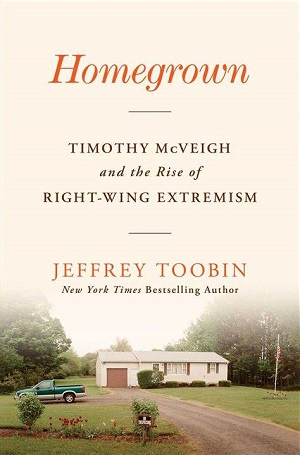 The book:
Homegrown is the opposite of a timely book, coming out nearly thirty years after the events it describes and the extensive media coverage it attracted. Ten years ago I reviewed a book on the subject – Oklahoma City: What the Investigation Missed – and Why It Still Matters by Andrew Gumbel and Roger G. Charles – that took a very critical look at the investigation and the question of whether McVeigh and Nichols were working alone. Jeffrey Toobin doesn’t mention Oklahoma City and I don’t know if he even read it, but he takes the opposing side, praising the efforts of law enforcement and arguing that there were no shadowy connections between McVeigh and various right-wing militia movements.
Which is not to say he doesn’t see McVeigh as part of the same tide of extremism that was swelling in America at the time and that later crested in the Capitol riots of January 6, 2021. The connection to the Capitol riots, and “the rise of right-wing extremism” more generally in the wake of the Oklahoma City bombing is the main point Toobin wants to drive home. This he does repeatedly. Flipping to the index I found January 6 referenced over 30 times. It usually sounds like this:
The right-wing extremists of the 1990s employed the same kind of violent imagery that their successors would use more than twenty-five years later. Before Oklahoma City, [Rush] Limbaugh spoke of how close the nation was to “the second violent American revolution,” just as Donald Trump told his armed supporters on the Ellipse on January 6 to march to the Capitol and “fight like hell.” On both occasions, actual violence followed broadcast incitement. Clinton believed that this kind of language had real-life consequences, but that wasn’t the kind of conclusion that could be tested in a court of law. In contrast [Merrick] Garland and others in the Justice Department refused to tie the bombing case to contemporary politics, believing that such analyses could only confuse a straightforward criminal trial. Thanks to the reticence of Garland and his colleagues, as well as the tunnel vision of the journalists covering the case, the impression lingered that McVeigh was an aberration, a lone and lonely figure who represented only himself and his sad-sack co-defendant. This notion, as history would show, was mistaken.
Or:
The events of January 6, 2021 saw the full flowering of McVeigh’s legacy in contemporary politics. McVeigh was obsessed with gun rights; he saw the bombing as akin to the revolutionary struggle of the Founding Fathes; and he believed that violence was justified to achieve his goals. So did the rioters on January 6.
And so on. From their embrace of violence, performative rage (“the fight – was the end in itself”), fetishization of the Second Amendment, invocation of the spirit of ’76, and inspiration drawn from The Turner Diaries (elevated into a kind of sacred text), a clear line runs from McVeigh to today’s right-wing militias. What has mainly changed is the way the Internet and social media now allow for greater mobilization of the “army” that McVeigh could only dream of. McVeigh read books and listened to the radio and shortwave. He wrote letters to the editors of local newspapers and to his representatives in congress. He met up with kindred spirits in the flesh at gun shows. What he “lacked was something that hadn’t been invented.” “The digital radicalization of McVeigh’s descendants,” Toobin notes, “was much faster and more efficient.” “More than any other reason, the internet accounts for the difference between McVeigh’s lonely crusade and the thousands who stormed the Capitol on January 6, 2021.”
I’m in broad agreement with this point of view, as it’s part of a larger question that historians and pundits have been discussing ever since the rise of Trump: to what extent did Trump and his MAGA movement mark a significant break with traditional Republican values, and to what extent was he the culmination of the American right’s long slide into violent insanity? Toobin clearly comes down on the side of continuity, and I think he makes a strong case. There were some places, however, where I thought he pressed too hard. At one point, for example, he tries to rope McVeigh in with “incel” culture:
McVeigh came of age before the term “incel” – involuntary celibate – came into wide use. Like the incels of a later day, McVeigh was unable to attract the sexual interest of women and responded with rage toward them.
This appears to be mistaken just on the basis of Toobin’s own reporting. For starters, I wasn’t sure what rage he was referring to, aside from McVeigh’s anger at his mother. But more to the point, McVeigh himself claimed to his lawyers that he’d had eight sexual partners, “three of them the wives of friends” (including the wife of Terry Nichols). A serial cuckolder isn’t an incel, and I wouldn’t have thought having eight partners by one’s early 30s was considered batting at such a low average as to be described as “unable to attract the sexual interest of women.”
Even without knowing anything of McVeigh’s sexual history, my own knee-jerk reaction against calling him an incel had to do with his height. Are there many tall incels? According to dating data, height is a primary (if not the primary) sexual selector, and McVeigh at 6’3” would be considered pretty much ideal in this regard. In comparison, famous killer incels Elliot Rodger and Alex Minassian were both 5’9,” which isn’t short but didn’t make them irresistible.
I’ve noted this dangerous predilection women have for tall men before in these notes, and the point here is that just by being 6’3” McVeigh seems to have had no problem attracting at least some women, despite having no job, living out of his car, and only possessing average looks combined with a rebarbative personality. But he also seems to not have been that interested in women anyway, or bothered seeking them out, which sort of kills your chances. In any event, it’s interesting that he took exception to a New York Times story that considered him to be “asexual” because he did his own dishes – a judgment that shows how facile such analyses can be.
Calling McVeigh an incel though isn’t just another way to tie his case in with more recent cultural trends but is part of the usual pattern, at least among not very good writers, of painting a villain as black as possible every chance you get. McVeigh was an evil man, but having said that, what purpose is served by calling him an incel, or a coward? Here is Toobin trying to explain “the real reason” why McVeigh didn’t shoot Charlie Hanger, the officer who arrested him:
In Iraq, McVeigh could fire a projectile from a Bradley and still strike a target far off in the distance. In Oklahoma City, he could put in his earplugs and set off a bomb that targeted faceless federal employees he would never see. But McVeigh never had the guts to kill a man face-to-face.
This struck me as a really cheap shot, and stupid. Because why does it take guts to kill someone face-to-face? I would have thought that this was just the mark of a psychopath. Would killing Hanger have made McVeigh more of a man?
I guess this is a minor point though, when placed in context. Overall I thought Toobin did a good job here retelling the story, though I was surprised given the amount of material he had to mine (courtesy of McVeigh’s lawyer rather dubiously donating all of his material on the case to a library in Texas) how little here is actually new. But did we not know all about McVeigh before this? What was there to find out? Toobin seems mainly intent on putting to rest ideas that McVeigh had help from anyone other than Nichols and Michael Fortier. This seems pretty convincing, though I wouldn’t be surprised if some of the “clutter” that the prosecution didn’t want to bring into their case might have also included other individuals or even groups who were to some degree in the know.
I also wasn’t as impressed as Toobin by the efforts of law enforcement and the prosecutors. They did their job. But the fact is this was as open-and-shut a case as you could imagine. Toobin frankly calls McVeigh’s defence to be “hopeless.” It’s also true that McVeigh was apprehended by accident, after being pulled over for failing to attach a licence plate to his car (much the same way Peter Sutcliffe, the Yorkshire Ripper, would be caught). Nichols, for his part, would basically turn himself in. Then, after McVeigh was in custody he pretty much gave himself up and wanted to sound a call to arms/become a martyr to his cause. The fantastic sums his lawyers were provided to defend him seems mostly to have been wasted on what were basically just expensive vacations.
The most disturbing thing in the book though is the conclusion Toobin draws: that what was once extreme has become mainstream. The so-called Overton window has shifted. To take just one example:
The McVeigh prosecutors put the “civil war” issue in front of the jury to show how extreme and exotic the defendant’s views were. But a quarter century later, McVeigh’s view was close to the conservative movement norm. This view – about the possibility of civil war – became mainstream as the passions underlying the January 6 insurrection roiled conservatives during the Biden presidency. According to an Economist/YouGov poll in the summer of 2022, 43 percent of Americans believe it’s at least somewhat “likely” that “there will be a U.S. civil war within the next decade.” More than half of Republicans feel that way, and 21 percent of “strong Republicans” believe a civil war is “very likely.” McVeigh’s extremism had spread to much of the contemporary Republican Party.
First you imagine these things happening. Then you calculate their possibility. Then you start talking about them as inevitable. And then they happen.
Noted in passing:
There’s long been a theory about how the American West has traditionally acted as a kind of safety valve for the discontents of “civilized” modern life. I don’t know if McVeigh was aware of this, but on some level he clearly was tapping into it in his understanding of the kind of American past he wanted to return to: “I want a country that operates like it did 150 years ago – no income taxes, no property taxes, no oppressive police, free land in the West.” The frontier thesis of Frederick Jackson Turner is still in play, at least in some minds.
I’ve written before about the strange way that some cases strike the fancy of the public and stick in the public consciousness more than others. At around the same time as the Oklahoma City bombing trial was going on (in Denver) there were the O. J. Simpson civil trial and the JonBenét Ramsey murder, and it’s hard to say if the bombing will last longer in memory than either of those. That may sound callous and even cruel, but as Toobin points out at one point it may have been technically inaccurate to say, as many media figures and even the FBI did at the time, that the bombing was “the deadliest act of homegrown terrorism in U.S. history.”
It was not; indeed, the bombing was not even the deadliest terror attack in Oklahoma history. In June 1921, a white mob in Tulsa conducted a pogrom and killed about three hundred Black residents of the city’s Greenwood neighborhood. In the aftermath of the Oklahoma City bombing, the Tulsa race massacre was scarcely mentioned.
Actually, before there was a spate of interest thrown up by a book and documentary recently, I think the Tulsa race riots had been almost completely forgotten. Similarly, the Bath, Michigan school bombing of 1929, which killed 44 people (38 of them students) is an event that very few people know anything about today. Or take this list that Toobin provides in talking about the 1994 bill before Congress to ban assault weapons:
Assault weapons – that is, short-stock semiautomatics, with magazines for multiple rounds – had figured in several recent mass murders at the time. In 1989, a teacher and thirty-four children were shot by an intruder in an elementary school in Stockton, California, in 1991, a gunman killed twenty-three people at a Luby’s restaurant in Killeen, Texas; eight people were killed in a San Francisco law firm in July 1993. (Notably, as the roll call of mass shootings continued in subsequent decades, these horrors have been largely forgotten.)
Guilty as charged. I pulled a blank on all of these, though the Luby’s shooting did ring a distant bell.
It really is impossible to say what historical events, or cultural artefacts, are going to stay with us. Here, for example, is a bit Toobin takes from the summation of McVeigh’s lawyer, Stephen Jones:
Forty years ago this very month, there was a major literary event in this country. James Gould Cozzens’ great novel, By Love Possessed, was published. And for people of my generation and my mother and father’s generation, and I’m sure some but not all of you, that novel remains with us today, though its author has long since been forgotten. The book was an instantaneous best seller. It stayed at the top of the New York Times best seller list for over a year. It was a Reader’s Digest condensed book. It won for the author not only the Howell prize but a cover story on Time magazine. And eventually as you might expect, it was made into a movie and then translated into some 14 or 15 languages throughout the world.”
Again, and perhaps with even greater embarrassment, I have to plead guilty. I couldn’t remember ever having heard of By Love Possessed, book or movie, before this, or for that matter of the Howell Prize (technically the William Dean Howells Medal, which Toobin also must not have known anything about). I know I must have at least read Dwight Macdonald’s review, but there’s no memory of any of it now. The author, I can testify, has indeed “long since been forgotten.” This is just the way cultural memory works. Or doesn’t work.
Takeaways:
There’s nothing new about violent right-wing extremism in America. What has changed is how mainstream it has become. A lot of that is probably due to the Internet and social media, as people bring the poison into their homes and their phones, but it’s also due to the rot now spreading down from the top. All of which makes me think that it’s probably impossible now to root out.
 Alex Good
I have to ask, what do you think people are supposed to think when the other side is moving to the left just as fast, if not faster? It’s not that the right is moving alone that will cause a civil war, but the lefties as well. America is splitting along broad ideological lines of what the role of government should be in our day to day life. And since legislation now gets used as a weapon, at some point policies are going to have consequences.
We’ve already seen this with the BLM movement and those “we’re our own country” zones in some of the big cities a few years ago. But the media loves those guys, so they get all positive press so nobody seems to care.
And I’m just going to stop before I set myself off into a froth, hahahaha 😀
LikeLiked by 1 person
I actually think that’s an argument that might work better in Canada, where the left recently anyway has been acting out in a worse way and the government has been used as more of a tool. In the U.S. I don’t see as much of an equivalency. I think the right has pushed things further and the Republican party has been going bonkers. But that’s an outsider’s point of view and I don’t take things any deeper.
LikeLiked by 2 people
That’s funny.
Because I woke up early and was going to come over here and make a joke about Trudeau passing a draconian bedtime law and that you all needed to unite against it. Then I read this and well, that idea went straight out the window 😀
LikeLiked by 1 person
Well, his dad said the state had no place in the bedrooms of the nation so I think I’m going to be allowed to keep going to bed as early and getting up as early as I want. In fact, I need to get back to bed pretty soon . . .
LikeLiked by 2 people
Which bookmark do you use for this? One of Nana’s?
LikeLike
Only envelopes are used for reading books under review, so that I can make notes on them. Nothing from the collection.
LikeLiked by 1 person
“First you imagine these things happening. Then you calculate their possibility. Then you start talking about them as inevitable. And then they happen.”
The newspaper and other media keep banging on about Ww3 being around the corner here, talking about conscription when Russia kicks off properly and the Middle East goes tits up, so a US civil war might be subsumed by the bigger picture, but then again, maybe not, they took their time to get into 2. McVeigh sounds like a nut job, but there’s plenty more where he came from.
LikeLike
Ugh. They’re really talking about us being close to WW3? I mean, I guess anything could be a trigger. I don’t see the alliances shaping up in the same way as the first two though. It feels more like Russia against the world now, which I don’t think they want to risk.
LikeLiked by 1 person
I’m hoping we won’t find out.
LikeLike
In today’s paper – “Defence secretary Grant Shapps warned that the world is “moving from a post-war to pre-war world” and the UK must ensure its “entire defence ecosystem is ready” to defend its homeland. In another ominous intervention last month, the head of the army General Sir Patrick Sanders said Britain must be prepared to form a “citizen army” of tens of thousands in the event of war with countries such as Russia.”
Everyday it pops up in some way or another.
LikeLike
You may well be asleep by now, but wanted to read this over before making a serious response. Reading Booky’s comments too. Going back to 2016, I felt there were two compromised candidates, both with connectons which made them unsuitable to lead. Jan 6th took the Republican party in the worst possible direction, and the longer that continues, the more cover it provides the Democrats; no-one is asking the difficult questions of them right now, and that won’t change while Trump’s criminality is centre stage. At the time, we thought McVeigh was an outlier, but when both sides are becoming more extreme, and I’d agree with Booky on this, it’s obviously that the media are only focused on one side of the polarisation.
I’m 5 foot 10.
LikeLike
Yeah back in 2016 you had the two most unpopular candidates in history running against each other. Hillary is a smart person, and an experienced politician, and I’m just gobsmacked she didn’t see what was coming. Apparently Bill did.
I agree that as long as Trump is around he makes the whole political conversation about himself, so that people don’t notice the other things. But he is a special category of threat to their system of government so I get it.
LikeLike
Shorty.
LikeLike
Hey, I’m 5’10”. But I’m bald. Eddie probably has his hair done up in a spiky ‘do that gives him an extra inch.
LikeLiked by 1 person
I think Shorty McDix is also follically challenged.
LikeLike