
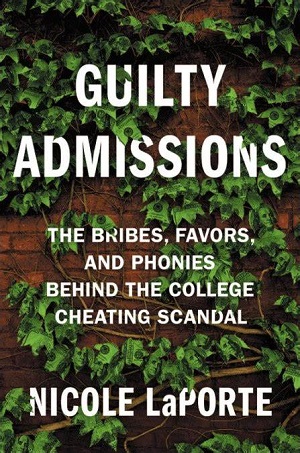
Guilty Admissions: The Bribes, Favors, and Phonies behind the College Cheating Scandal
By Nicole LaPorte
The crime:
Throughout the 2010s a college application counsellor named Rick Singer got some of his wealthiest clients to pay him to arrange their children’s acceptance into prestigious American universities. He did this primarily through two different “side-door” processes: (1) the creation of fake athletic profiles that were sent to coaches who were in on the fix, or (2) having a professional test-taker complete the standardized entrance exams, boosting the applicant’s score into the highest percentiles. The FBI investigation into the conspiracy, codenamed Operation Varsity Blues, resulted in over 50 charges being laid, with the mastermind Singer sentenced to three-and-a-half years in prison plus forfeiture of over $10 million.
 The book:
This was actually the second major book about the Varsity Blues scandal, the first being Unacceptable: Privilege, Deceit and the Making of the College Admissions Scandal by Melissa Korn and Jennifer Levitz, which Nicole LaPorte cites several times as a source. Both books were “timely” though, being published quickly to take advantage of public interest in the case. As it is, things break off here with the March 12 2019 announcement by the FBI of the results of the investigation and then, in an “Author’s Note,” dashing through some of the highlights from the pleas and sentencings.
When the story first broke I remember being underwhelmed by it. Nothing about it struck me as surprising, or particularly heinous. Just a bunch of very rich people who thought – not unreasonably – that they could buy anything. When I went to university there were various incidents of cheating that I could never get that exercised about. I was there to learn something; what other people were up to, what shortcuts they might have been taking just so they could get their piece of paper, didn’t interest me. It didn’t bother me at all if they weren’t doing the work. If they were there paying tuition then it was all good as far as I was concerned.
The admissions scandal was something a bit different in that less qualified students were getting into elite institutions and in doing so taking spots away from stronger applicants who were playing by the rules. But even so, it’s understood that there’s no level playing field when it comes to going to the top colleges and universities. There are legacy admissions, or the “front-door” expedient of just making a huge donation. There are the “special accommodations” made for testing students with “anxiety,” something which overwhelmingly afflicts the wealthy. And then there is the vast gray area full of ways of playing the system that aren’t illegal or even frowned upon that tilt the odds in your favour. Who can afford independent counselling that can cost tens of thousands of dollars in the first place? And what do such counselors do? I laughed out loud, for example, at this little gem: “Independent counselors don’t write a student’s college essay, but rounds of edits and proofreading are provided, giving the student a distinct edge over those who are left to their own devices.” I’ve worked as an editor and I can assure you that “rounds of edits,” especially on a short piece written by someone who can’t write, amounts to, you know, a total rewrite. And given how much they’re being paid, and what’s at stake (including their own reputations), I’d imagine most of these counselors are doing more than that.
I could only wonder at how obsessed the wealthy families LaPorte describes are with status. Despite the fact that going to a top university isn’t going to affect any of these children’s lives, their parents were “just as desperate about college admissions as families without their wealth and connections.” Why?
Because of their high-profile names and the company they kept – the jobs they held, the philanthropy circles they ran in, the country clubs they were members of – having their child anointed by a top-tier school wasn’t a preferable option; it was considered essential in order to keep the family name intact, and the aura of success and perfection. It was status maintenance of the highest order. In many cases, parents simply felt it was their right, something they were entitled to, regardless of what means were required to reach that end.
Ah, “entitlement.” Along with its close companion “privilege” it shares a special place in today’s language of opprobrium. But behind all of its perversities and delusions there’s a reality that LaPorte is alert to. That reality is fear.
The anxiety isn’t limited to wealthy parents living in Bel-Air or Beverly Hills. It’s an endemic that’s become a universal among almost all the parents who plan to send their child off to a four-year institution in the hopes of launching them successfully into the world. Indeed, for middle-class families, who don’t have a cushion of wealth and resources to fall back on, one of the most significant rites of passage for an American teen has become fraught with fear. The fear stems from the extreme wealth divide in our country, and the belief that simply getting a college degree – any college degree – no longer implies upward mobility the way it once did. Given the current state of affairs in the United States – the endless headlines about burdensome student debt, the high cost of living, and the growing unemployment rate for college graduates – the desire for an impressive college degree is not just a lofty wish; it’s a do-or-die imperative.
This is fine as far as it goes, but that fear grounded in an awareness of “the current state of affairs in the United States” and its “extreme wealth divide” has a deeper resonance. It’s not just the fear of not getting in or being left behind but also the fear of falling. White people, a former Stanford dean opines, are “terrified, because they’re losing a privilege that they never realized was a privilege” (a pretty good definition of entitlement). And those lucky enough to have found themselves living in Bel-Air and Beverly Hills are only sure of one thing: they never want to lose any part of the lifestyle to which they’ve become accustomed. To be thus is nothing, but to be safely thus . . .
Status maintenance is then a priority for those suffering from status anxiety, and the parents profiled here had the worst possible case of that. After all, by their actions they as much as admit that they don’t believe in the notion of America as a meritocracy. Indeed, they see such notions as being for suckers. How then to stay on top? By rigging the game.
Guilty Admissions is an eye-opening tour of the epicenter of the affluenza pandemic. And it’s an insider’s account too, as LaPorte is resident in the same neighbourhood, with her two kids attending one of the exclusive schools she describes. Being a part of this world, she is able to provide a lot of insight into a world that I didn’t even know existed. Take, for example, the “budding industry of kindergarten-prep tutors and companies,” with one the most popular services offering “one-on-one tutoring, for $350 an hour, to help children master the skills they will need for kindergarten.” This is a thing.
LaPorte has sympathy for the parents (as noted, she is one herself), and her account of the environment of “competitive parenting” that Singer exploited is valuable. But at one point in the story this fellow-feeling does lead to an unintentionally hilarious, and revealing, use of language:
At times, the parents’ spiritual wrestling was painfully palpable, as when Caplan said on a call to Singer. “It’s just, to be honest, I’m not worried about the moral issue here. I’m worried about the, if [his daughter’s] caught doing that, you know, she’s finished.”
Did you get that? The parent isn’t worried about moral issues but only at how his daughter might lose status if she’s caught. This is what counts as “painfully palpable” “spiritual wrestling” in this world!
If status anxiety among the uber-wealthy is one part, the demand part, of the criminal equation, the supply side was provided by Rick Singer. It’s become easy to track everything in the Age of Trump back to the example of the president during the time when Singer’s enterprise was in its fullest swing, but given that the shoe fits so well I have no problem with putting it on again. Singer was an inveterate and indefatigable hustler and con man who took personal-branding and “truthful hyperbole” (Trump’s preferred euphemism for lying) to new levels. And if he was lying all the time then he just assumed that’s what everyone else was doing, or would want to be doing, too. Anything that would help grow not the individual but the brand. “If you’re not cheating, you’re not winning,” was the age’s mantra. And if you weren’t winning you were a loser. The rich would get richer and everyone else would go extinct, which is an observation not limited to individuals. Many colleges and universities would find themselves going under at this time, while the “elite” schools with brand recognition and huge endowments would keep getting richer.
But even the richest most well-endowed universities were grubbing for cash. Like everyone else, they could never get enough. “The culture [at USC] was one of enrichment at all costs, and multiple scandals would come to light down the road as a result.” But wasn’t all the scandal just the price of winning? Everything about the Varsity Blues case comes back to this point: was what Singer was doing really that out of the ordinary? Was it even that bad? The great thing about Guilty Admissions is that it demands we answer these questions for ourselves, forcing us to think hard about how the modern class structure affects all of us today.
Noted in passing:
Those twin demons of entitlement and privilege can reveal themselves in truly shocking ways. All the more shocking for being expressed so matter-of-factly. I already mentioned the demented sense of grievance and of being somehow cheated that pervades all levels of society today, and that the wealthy families who sought to rig the game by Singer’s side-door methods were representative of this. What’s amazing is the way they justified what they were doing by seeing the game as being rigged against them. Why, they were just fighting back against an unjust system! When Singer explained how he proposed to raise the SAT score of one client’s daughter he referred to it as a way to “level the playing field.” Later, that same client would write a letter to the judge sentencing her that she had only wanted to give her daughter “a fair shot.” It tells you something when even the most fortunate among us, and we’re talking about the 0.01% here, feel so hard done by.
Takeaways:
It’s not being cynical to feel that life isn’t fair and that we don’t live in a meritocracy. The game really is rigged. There was a time, however, when the winners weren’t quite so arrogant, deluded, and willfully destructive of the social fabric. That was a long time ago though, and I don’t see how there’s any way we’re getting back to health.
 Alex Good
‘The parent isn’t worried about moral issues but only at how his daughter might lose status if she’s caught’
This is the Age of Trump, and it’s not over yet. There’s a reason that we’re looking back to Germany in the 1930’s for comparisons, there’s been nothing that puts America in a worse light. While these people are laughably incompetent, they’re also dangerously immoral and the rot starts at the top.
LikeLike
They way they try to excuse their behaviour really is painful. And yeah, Trump set a terrible example. If the way he did business was OK, then what wasn’t?
LikeLiked by 1 person
Considering how some presidents of universities just this past week couldn’t publicly say that calling for genocide of the jews was against school policy, I don’t think the rot is just in the attendees, but is endemic in the whole institution.
LikeLike
There’s a lot of bloat, and rot, in university administration. Higher education is in trouble on a lot of different fronts.
LikeLiked by 1 person
Part of me would like to be enraged, but I know that’s just how the world works in general, not the world really, people.
LikeLiked by 1 person
Yeah, to be honest it never even bothered me when I was in university. I always figured if other people wanted to cheat because they just wanted to get through without doing the work or learning anything, then they could go ahead. Didn’t feel like it impacted me. This was a bit different because it had to do with admissions, but basically these kids were going wherever they wanted and they all had it made so their education was just a status symbol anyway.
LikeLiked by 2 people
This post really resonates. Between the college admissions scandal and the troubling silence on anti-Semitism in academic circles, it’s clear there are deep-rooted issues in our education system. It’s frustrating and unfair, to say the least. I appreciate your candid take on these complex problems. We need more honest discussions like this.
LikeLike
Thanks Raymond.
LikeLike