
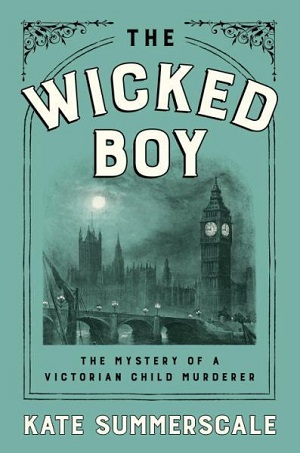
The Wicked Boy: An Infamous Murder in Victorian London
By Kate Summerscale
The crime:
IN 1895 13-year-old Robert Coombes killed his mother. His father was away at the time, and after the murder Robert spent the next week and a half living with his younger brother Nattie and entertaining a simple-minded friend of the family while his mother’s corpse rotted in an upstairs bedroom. Eventually, concerned neighbours and family members came to investigate and the smell gave everything away. Robert would stand trial and be found not guilty by reason of insanity. After 17 years in Broadmoor Hospital for the Criminally Insane he was released and immigrated to Australia. He would subsequently serve with distinction in the Australian army in the First World War and, after the war, settled down as a small farmer.
 The book:
I’m on record as having been underwhelmed by Kate Summerscale’s much-lauded second book The Suspicions of Mr. Whicher. She seemed to me to be a dry writer a little too given to information dumps, and I didn’t have much, or really any interest in the back half of that story, which tried to reconstruct Constance Kent’s subsequent life in Australia after the Road Hill House murder trial. Nevertheless, it was a surprise bestseller and Summerscale has gone on to become a big name in the genre of historical true crime.
I’m not knocking her success. She puts the work in and picks interesting subjects to explore. With The Wicked Boy she follows a very similar case to that earlier book. Once again we have the sensational case of a killer child in Victorian days, and once again the killer immigrates to Australia after the dust settles. That said, I thought The Wicked Boy a better book.
I think this is primarily because Coombes himself is such a fascinating figure. Fascinating and downright impressive in many ways. It’s a cliché that kids had to grow up faster in days of yore, and that life among the working poor in Victorian England was no picnic, but it’s still worth keeping in mind the fact that Coombes grew up in a working class family at a time and in a place when working class meant something really horrible. Already at 13 Robert had finished with his schooling and was employed in an East End dockyard as a “plater.” I’m not sure all of what this entailed, but it sounds like it would involve a lot of pretty strenuous physical labour, especially for a 13-year-old. Primarily, Summerscale tells us, they would “run errands and mind machines” but also help out in “cutting and shaping sheets of iron on a lathe, placing them on moulds and bending them into shape.”
Kids were just more capable, not to mention independent, in that day. A year earlier, when he was 12, Robert had left the house and journeyed 40 miles down the Thames on his own just to see the court appearance of a notorious murder suspect. Three years earlier, when he’d been only 10, he’d robbed money from his parents’ cashbox and run away with Nattie all the way to Liverpool. It’s hard to imagine many 10-year-olds managing for themselves that well today, even with better rail service.
This competence and independence was something characteristic of those times. I don’t want to make it sound like a golden age, because it certainly wasn’t, but you simply can’t fail to be impressed at Coombes’s many achievements. As noted, his schooling was done by 13, by which age he was already a smoker. He did not come from a background of any wealth or privilege. After killing his mother he was sent to a criminal asylum and then a Salvation Army halfway-house program before leaving to Australia. And yet through all this he learned to be an efficient tailor, was a better-than-average musician (playing various instruments from violin to cornet and leading his unit’s band while in service), won several medals in the military as a stretcher-bearer while participating in some of the First World War’s worst campaigns (Gallipoli and Passchendaele), played chess at a very high level, and then after the war, without having any kind of a background in agriculture or animal husbandry, ran a dairy farm and was a highly-regarded raiser of vegetables that he sold locally. When his house burned down he was able on his own to build a cabin, however rudimentary, to replace it.
These are accomplishments that today I couldn’t match. I grew up on a dairy farm and did a fair bit of gardening so I might be able to shuffle by with that part out of muscle memory. But I can’t play any musical instrument, couldn’t sew on a button, and my chess is barely at a beginner’s level despite playing a lot online. I’m not a handyman and so probably couldn’t put up much in the way of a shack even with an unlimited account to draw on for supplies from a home hardware store. Would an online tutorial help? I was briefly in the reserves, but imagine that if I’d ever been at Gallipoli or the Western Front I would have been blown up pretty quickly (though admittedly, survival in this regard would mostly come down to luck).
I’m reluctant to invoke labels like the “greatest generation,” but when I think back to my father’s and grandfather’s generations (my father was born in 1923) and look at their accomplishments I can’t help but notice a pretty steep drop off. It’s not just that adversity builds character, since they were reasonably well off, but rather that more was expected of them. Then with the dread Boomers and John Kenneth Galbraith’s affluent society everything went to hell. But just thinking about this gets me down.
Getting back to the book, it follows Summerscale’s interest in the major social and cultural questions of the day, from what was seen as the malign influence of the penny dreadfuls that Coombes was fond of reading (the violent videogames of their day) to the slapdash state of criminal psychology. But then, even by today’s standards it’s hard to tell what led Coombes to kill his mom. I guess a “psychotic episode” (the modern diagnosis that’s offered) is a bit more convincing than “homicidal mania” (a contemporary one), but that may only be because I’m more used to the newer terms.
What makes this a special book though is the revelation at the end of the character of Robert’s life in Australia and the big difference he made in the life of a neighbouring boy. It’s not just that he came out the other side of all he experienced intact. More than that, his is a dramatic tale of redemption. Which leads to another troubling reflection about then vs. now. Did the justice system, at least in some cases, actually do a better job of rehabilitation in those dark ages than it does now? Would a Robert Coombes today turn out as well?
Noted in passing:
When dad was away, 13-year-old Robert slept in bed with his mother.
Summerscale doesn’t get into a discussion of how typical this was of family sleeping arrangements at the time, but it certainly struck me as weird. It’s not like there wasn’t another bed he could sleep in (presumably with his brother). It was at this same time that Freud came up with his theory of an Oedipal complex.
Takeaways:
Your neighbour might be a killer or a hero. Or both. And you’d never know.
 Alex Good
Gotta keep an eye on those neighbors. They’re always villains until they’ve proved they’re not. That’s my SOP.
LikeLiked by 1 person
Not a bad plan. Good fences, and I mean walls topped with razor wire, make good neighbours.
LikeLiked by 2 people
Machine guns, land mines and zombie dogs help too.
♪Like a good neighbor♪
♪Bookstooge isn’t there♪
LikeLiked by 1 person
Moats filled with alligators don’t work in NH I guess.
LikeLiked by 2 people
Yeah, when you’re in a condo, the associations really frown on them. Dead, frozen alligators really stink come spring time…
LikeLiked by 1 person
He sounds like a good chap really. Can’t help thinking there was something wrong on the mothers side.
LikeLiked by 1 person
He turned out amazingly well. Hard to figure what went wrong with him when he killed his mom. Seems like just a really extreme example of kids doing crazy things.
LikeLiked by 2 people
The fact that mom had him in her bed when hubby was away didn’t sit well with me, but different times I guess.
LikeLiked by 1 person
That was a weird one. But like you say, different times. It might have been semi-normal.
LikeLiked by 2 people
What is a ‘mind machine’ and do you have any pics of one?
LikeLike
“Mind” as verb, not adjective. He was minding the machines. It was what kids did back in the day.
LikeLike
LikeLike
Getting their hair done?
LikeLiked by 1 person
yes, but it does look like some old sci-fi movie brain drain equipment!
LikeLike
I was wondering if it might be from an old SF movie. But I guess someone just wanted curly hair!
LikeLike