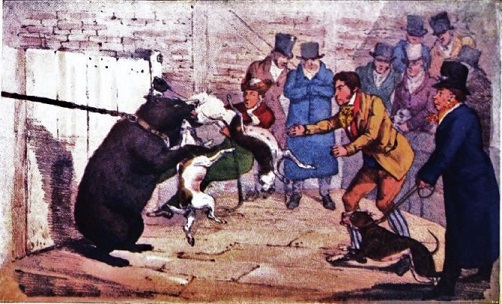
At one point in his biography of William Shakespeare, Anthony Burgess goes on a bit of a digression on the subject of bear-baiting:
In its classic form, a bear was put in a ring, sometimes tethered to a stake, and set upon by mastiffs; but bears were expensive investments, so other animals (such as bulls and horses) were commonly substituted. One variation was to put a chimpanzee on the back of a horse and let the dogs go for both together. The sight of a screeching ape clinging for dear life to a bucking horse while dogs lept at it from below was considered about as rich an amusement as public life could offer. That an audience that could be moved to tears one day by a performance of Doctor Faustus could return the next to the same space and be just as entertained by the frantic deaths of helpless animals may say as much about the age as any single statement could.
I don’t know why anyone should find this surprising. Sensational, exploitative, and cruel forms of entertainment have always been popular, and not just among the unwashed masses. Why should people who enjoy Renaissance drama not be as fond of sex and violence as anyone else? And how pure was Renaissance drama anyway? Titus Andronicus is pretty rough.
And it’s not just audiences that are like this. Lots of great artists have been individuals of low morals and lower taste. Personally I don’t think I would have ever gone to see gladiators, bear-baitings, witch burnings, or public executions back in the day, but I do like to watch stuff that a lot of people (and I wouldn’t always disagree) would consider to be crap that’s both offensive and immoral. I think Burgess probably did too. I also, like Burgess, enjoy reading Shakespeare. I don’t think that tells us anything about our current age so much as it’s a comment on human nature.
 Alex Good
I’ve stopped reviewing bear baiting, even though its better than Shakespeare; my readers don’t seem to enjoy either. You still can’t even show Cockfighter in this country without the fuzz descending on you.
LikeLike
I thought you drove the bears in Scotland into extinction through excessive baiting. You have only yourselves to blame.
LikeLike
Glad you at least realize most of the movies you review are crap 😉
LikeLike
90% of everything . . .
https://en.wikipedia.org/wiki/Sturgeon%27s_law
LikeLiked by 1 person