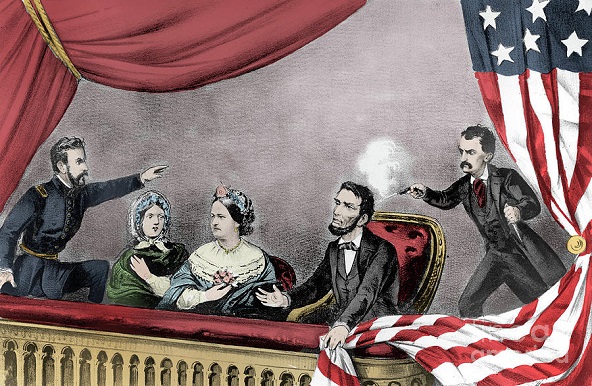
Aside from that, Mrs. Lincoln . . .
Recently, while reading Heather Cox Richardson’s How the South Won the Civil War, I came across the following passage:
The process of constructing a new nation based on the idea that all men — and possibly women — were created equal would require the deft hand of someone like Abraham Lincoln. But on April 14, at Ford’s Theatre in Washington, the actor John Wilkes Booth shot him in the back of the head in one last, desperate attempt to protect the oligarchic world of the Old South. As he jumped to the stage from the president’s box, Booth shouted, “Sic semper tyrannis” (thus always to tyrants) — Virginia’s state motto and the line Brutus speaks in Shakespeare’s Julius Caesar to justify his murder of the emperor.
This made me blink in surprise. While I knew Booth said these words after shooting Lincoln, I was pretty sure Brutus hadn’t used them in Shakespeare’s play. I turned to my bookshelf and a few seconds of flipping pages took me to Act 3 Scene 1 where I found what I suspected: Brutus doesn’t say anything when he strikes Caesar down.
Given that Julius Caesar is one of the better known works in the canon, remaining a staple even in high school, it seemed odd to me that a highly-regarded book by an academic historian published by Oxford University Press would have allowed such a mistake to get by.
Curious, I decided to dig a little deeper. At Wikipedia I found this:
John Wilkes Booth wrote in his diary that he shouted “Sic semper tyrannis” after shooting U.S. President Abraham Lincoln on April 14, 1865, in part because of the association with the assassination of Caesar. In the scene of Shakespeare’s Julius Caesar where Marcus Brutus assassinates Caesar, he yells the phrase, and the entire Booth family was well-known for their theatrical roles, Booth and his brothers having played roles in past productions of Julius Caesar.
Some of this is true. There’s no question Booth identified with the character of Brutus, and saw his killing of Lincoln to be an event on a par with the assassination of Caesar. After killing Caesar he said that he had only done “what Brutus was honored for.” And such a role was almost a birthright. His father, also a Shakespearean actor, was even named Junius Brutus Booth, and his brother Junius Brutus Booth Jr.
But again there is the assertion that “In the scene of Shakespeare’s Julius Caesar where Marcus Brutus assassinates Caesar, he [Brutus] yells the phrase.” This is the same thing Richardson says, and it’s not true.
Apparently no one is sure where the words originally came from. Again having recourse to Wikipedia we are told that “it has been suggested” that an ancestor of Marcus Junius Brutus said them upon expelling the current tyrants of Rome and thus establishing the Republic, “but the suggestion is not based on any literature of the time.”
Historical support for Marcus Junius Brutus using the expression upon killing Caesar is also slim. Wikipedia says this Brutus is “sometimes credited with originating the phrase” but an editorial note asks “by whom?” Not Plutarch, anyway. Or Shakespeare, who was using Plutarch as a source.
I’m not beating up on Wikipedia here. I love Wikipedia and it’s often the first resource I turn to when looking into questions like this. I also liked how they included the speculation of a Classics professor named Mike Fontaine that Sic semper tyrannis might be a Latin translation by an American in the eighteenth century of what Scipio Aemilianus said when he heard of the assassination of Tiberius Gracchus. That’s interesting.
What I raise an eyebrow at here is that Richardson may have accepted Wikipedia as her source with too great a degree of trust, and that nobody else caught it, either upon her book’s first publication or two years later when it appeared in paperback. Come on, Oxford!
 Alex Good
I hope you’ve written/emailed Ms.Richardson and informed her of the error of her ways!
LikeLike
I’m pretty sure I’m not on her radar. She hosts a very popular podcast where she talks about American politics and it’s good if a little unfocused. I was a bit disappointed in her book. I’m finding a lot of books nowadays (especially true crime ones) are coming out of podcasts and they’re almost all pretty weak.
LikeLiked by 1 person
More evidence of the ongoing dumbing down of the world’s inhabitants.
LikeLike